

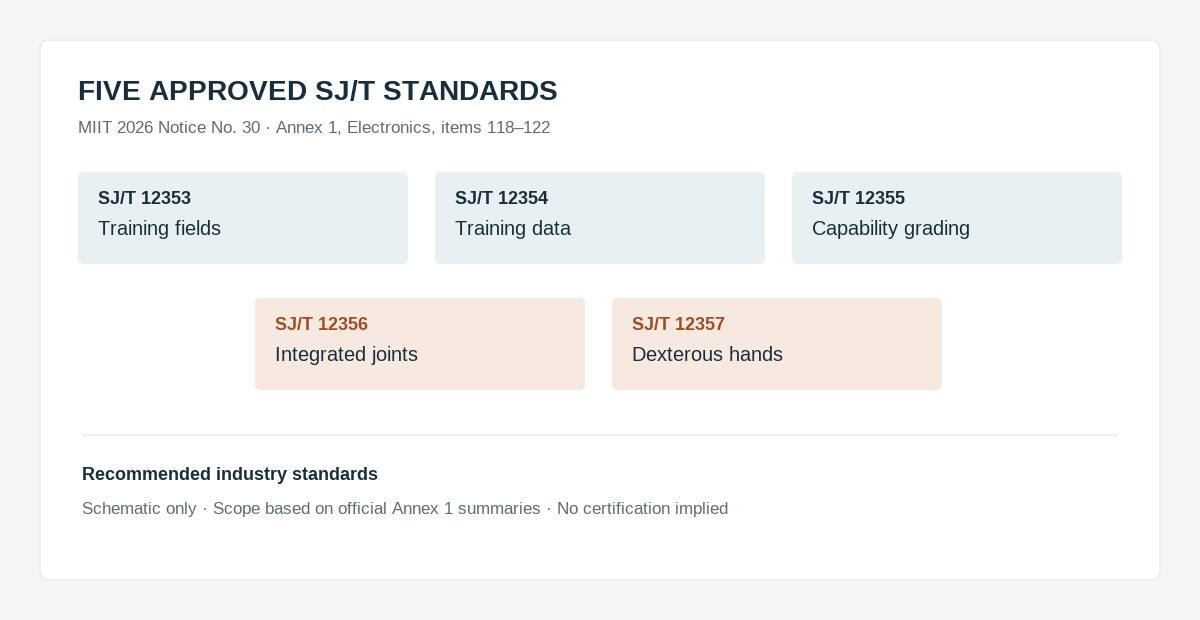
China’s Ministry of Industry and Information Technology (MIIT) has approved five dedicated electronics-industry standards for humanoid robots—covering training grounds, training data, intelligence grading, electrically driven integrated joints and dexterous hands.
The five standards appeared in MIIT Announcement No. 30 of 2026 (dated 10 November and posted online on 16 November 2026), alongside 269 other industry standards. According to the official annex, all five are brand-new documents rather than revisions of older rules, and each takes effect “from the date of publication” (the annex does not state a separate calendar date).
Before reading too much into the headlines, one distinction matters above all: these are recommended Chinese industry standards (SJ/T), not mandatory national laws. They do not create a government license or certification scheme, and they do not automatically apply in export markets. Their real impact is practical—giving Chinese manufacturers, test labs and buyers a shared technical vocabulary.
The five standards at a glance
Because Annex 2 of the announcement lists no official foreign-language editions for these five documents, the English titles below are unofficial translations of the Chinese titles in Annex 1. China Electronics Standardization Institute is named in Annex 3 as the organization responsible for publishing electronics-industry standards.
| Code | Official Chinese title | Unofficial English title | Effective date, as listed |
|---|---|---|---|
| SJ/T 12353—2026 | 人形机器人 训练场构建技术规范 | Humanoid robots — Technical specification for training-field construction | From the date of publication |
| SJ/T 12354—2026 | 人形机器人 训练数据管理要求 | Humanoid robots — Requirements for training-data management | From the date of publication |
| SJ/T 12355—2026 | 人形机器人 智能化能力分级 | Humanoid robots — Intelligent capability grading | From the date of publication |
| SJ/T 12356—2026 | 人形机器人 电驱动一体化关节技术规范 | Humanoid robots — Technical specification for electrically driven integrated joints | From the date of publication |
| SJ/T 12357—2026 | 人形机器人与具身智能 灵巧手技术规范 | Humanoid robots and embodied intelligence — Technical specification for dexterous hands | From the date of publication |
Note on scope of this review: RoboPallas has examined MIIT Announcement No. 30 and its official annexes, but has not yet obtained the full published texts of the five standards. Everything summarized below comes from the official Annex 1 summaries.
What each standard covers—and the fine print to watch
1. Training fields (SJ/T 12353—2026). Sets out how to plan, design, build and accept a humanoid-robot training ground—covering functional zoning, spatial layout, equipment and facilities, safety and ethics, environmental control, network infrastructure and test methods. Other intelligent-robot training facilities may also use it as a reference.
2. Training data (SJ/T 12354—2026). Covers the full lifecycle of humanoid-robot training data: collection, processing, storage, transmission, use, circulation and destruction. Other data-management workflows may reference it as well.
3. Intelligent capability grading (SJ/T 12355—2026). Defines the architecture of intelligent capability, a grading framework, grade definitions and assessment methods to guide R&D, testing, evaluation and real-world selection. Watch the marketing hype here: several Chinese media reports—citing the secretariat of MIIT’s humanoid-robot standardization committee—have described an L0-to-L5 scale across perception/cognition, decision-making/learning, execution, and collaboration/interaction. That detail does not appear in the official annex, and RoboPallas has not verified it against the full standard. Until the published test method is checked, treat any vendor’s claimed “L-level” in a brochure as unverified.
4. Electrically driven integrated joints (SJ/T 12356—2026). Covers appearance and structure, interfaces, performance, safety, electromagnetic compatibility (EMC) and test methods for motor-driven integrated joints in humanoid robots. Key exclusion: the official scope excludes small joints used inside dexterous hands. Other robot joints may use it as a reference.
5. Dexterous hands (SJ/T 12357—2026). Sets technical requirements and test methods for multi-fingered dexterous hands—including appearance, degrees of freedom, motion, sensing, grasping, object manipulation, interfaces, EMC, environmental adaptability and reliability—plus guidance on modeling, simulation and graphical representation. It applies to humanoid dexterous hands and can serve as a reference for embodied-intelligence robots and human-like manipulation in service, medical or smart-manufacturing settings.
Why “SJ/T” means recommended, not mandatory
In China’s standards system, the letters in a standard code tell you its legal weight:
SJmarks an electronics-industry standard./Tstands for tuijian (recommended).
Under China’s Standardization Law and the Measures for the Administration of Industry Standards (SAMR Order No. 86, in force since 1 June 2024), industry standards are recommended unless a law, administrative regulation or State Council decision states otherwise. In fact, SAMR’s rules explicitly bar industry standards from creating licensing, certification, approval or rating schemes, or defining regulator powers.
That does not mean SJ/T standards can be ignored. In practice, a recommended standard gains teeth the moment a buyer, tender document or supply contract writes it in as a technical requirement. Just keep the distinction clear: that obligation comes from your contract, not from Announcement No. 30 itself.
Three neighboring documents you shouldn’t mix up
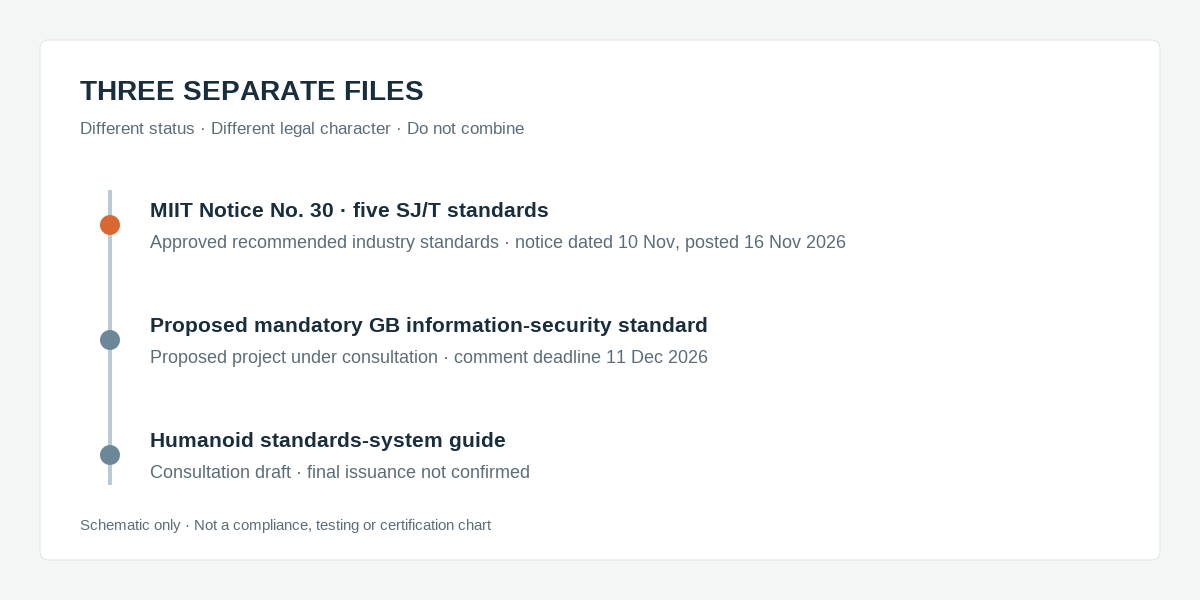
China’s robotics standards news moved fast in November 2026, making it easy to lump unrelated notices together. Keep these three separate from the five SJ/T standards:
- Embodied-AI data generation (
SJ/T 12398—2026): Approved in the very same Announcement No. 30 (and even listed first in the Chinese notice), Artificial intelligence — Key foundational technologies — Technical requirements for embodied-intelligence data-generation systems is a related standard, not one of the five humanoid-robot standards above. - The draft 2026 standards roadmap: On 24 August 2026, MIIT’s Department of Science and Technology released a draft National Guidelines for the Construction of the Humanoid Robot Industry Standard System (2026 Edition) for public comment (25 August–23 September 2026). That is a high-level planning blueprint, not these five standards, and RoboPallas has not confirmed a final official release.
- A proposed mandatory national standard on information security: On 12 November 2026, the State Administration for Market Regulation (SAMR) opened public comments through 11 December 2026 on two proposed mandatory national-standard (
GB) projects, including Humanoid robots — Information security requirements. It is still at the pre-initiation stage—not yet approved or numbered—and is separate from theSJ/Tpackage. If you are tracking future mandatory Chinese rules, this is the item to watch.
One more factual boundary: MIIT established its Technical Committee on Humanoid Robots and Embodied Intelligence (MIIT/TC8, secretariat at the Chinese Institute of Electronics) in late 2025. While Chinese media have credited TC8 with drafting these five standards, Announcement No. 30 and its annexes do not name TC8, so that attribution remains unconfirmed from the official approval notice.
What this means for the industry
Taken together, these five standards establish a clearer shared language across the hardest-to-compare parts of a humanoid robot: where it is trained, how its data are governed, how its intelligence is described and how its main joints and hands are tested.
When suppliers, test labs and buyers use the same definitions, it becomes much easier to compare products—and to spot when a marketing claim stretches past a standard’s actual scope. The joint standard is a textbook case: because SJ/T 12356—2026 leaves out small hand joints, a supplier claiming “joint standard compliance” is not covering the actuators inside a dexterous hand. Likewise, an intelligence “grade” means little until the full grading method is public and backed by a named test scope, test lab and test date.
How quickly Chinese factories adopt these documents—or whether future mandatory national standards build on them—remains to be seen.
Practical questions for buyers and sourcing teams
For procurement and engineering teams sourcing from China, treat these standards as a structured question list, not a stamp of approval:
- Ask for specifics, not slogans: Was the named
SJ/Tstandard used in design, internal bench testing or third-party lab testing? Which edition and exact clauses apply? - Check the exclusions: For integrated joints (
SJ/T 12356), confirm whether the component falls outside the small hand-joint exclusion. For dexterous hands (SJ/T 12357), ask which functions were actually tested—motion, sensing, grasping, manipulation, interfaces, EMC, environmental adaptability or reliability. - Audit data and training sites: For training data (
SJ/T 12354), ask how collection, storage, transfer, sharing and deletion are controlled, especially across borders. For training grounds (SJ/T 12353), ask whether the facility was designed or accepted against the standard’s safety, ethics, environmental and network provisions. - Demand the paperwork: A brochure badge never replaces a test report, a scope statement or a contract clause. Likewise, appearing in a public supplier directory is not a certification or endorsement—always verify product fit, certifications, lead times and after-sales support directly.
What overseas readers should (and shouldn’t) assume
For buyers in Europe, North America or other overseas markets, these Chinese recommended industry standards do not replace local legal requirements. They do not automatically translate into ISO, IEC, EN or national rules, and they do not satisfy destination-market obligations for machinery safety, EMC, radio compliance, data protection or product liability.
Still, knowing them pays off. Asking a Chinese supplier to map its design and test records to SJ/T clauses makes technical reviews sharper and faster. Just never treat SJ/T conformity as enough for import, deployment or insurance abroad. If a vendor claims a Chinese industry standard is “equivalent” to a European or international standard, verify both texts side by side—and confirm with the regulator or conformity-assessment body that actually governs your market.
Sources
- MIIT Announcement No. 30 of 2026 (Department of Science and Technology page): https://www.miit.gov.cn/jgsj/kjs/wjfb/art/2026/art_1ecfcc7030e949c79254b6fafa01f0fa.html
- Same announcement, government-disclosure mirror: https://www.miit.gov.cn/zwgk/zcwj/wjfb/gg/art/2026/art_eb2325cb1a844fe99958eb8d104a34fc.html
- Annex 1, list of 274 industry standards: https://www.miit.gov.cn/cms_files/filemanager/1226211233/attach/202611/6d2b9d84f80c435fb9c2feff84529863.pdf
- Annex 2, official English edition of one unrelated standard: https://www.miit.gov.cn/cms_files/filemanager/1226211233/attach/202611/ac7b3e0232d7410ca34462632cb5637c.pdf
- Annex 3, publication arrangements: https://www.miit.gov.cn/cms_files/filemanager/1226211233/attach/202611/9af33633e2734f63b098ccf3a746e2ec.pdf
- Standardization Law of the People’s Republic of China, Article 2: https://www.samr.gov.cn/zw/zfxxgk/fdzdgknr/fgs/art/2023/art_d7040b9f1d0f4980a0e55089a57bf37d.html
- Measures for the Administration of Industry Standards (SAMR Order No. 86, 2023): https://www.samr.gov.cn/zw/zfxxgk/fdzdgknr/fgs/art/2023/art_ebd7a79783c24f2cad31f29a8b0c0931.html
- Official codes for national and industry standards (1999 notice): https://www.sac.gov.cn/xxgk/flfg/art/2015/art_880615684ece4758b11fc5b2d07aea9b.html
- SAMR notice seeking comments on proposed mandatory national-standard projects, including Humanoid robots — Information security requirements: https://www.samr.gov.cn/bzjss/zqyj/art/2026/art_c2d24d77e2cb4363832437cb39c85af6.html
- MIIT Announcement No. 44 of 2025, establishing MIIT/TC8: https://www.miit.gov.cn/jgsj/kjs/wjfb/art/2025/art_91588a03c1694803b04f6e7674ac973a.html
- Draft 2026 guidelines for the humanoid-robot industry standard system, consultation notice: https://www.miit.gov.cn/jgsj/kjs/jscx/bzgf/art/2026/art_ef26915b2f0843d58a22f5a090690195.html