
A strain-wave gear reduces speed in a compact package
A harmonic drive is a commercial name often used for a strain-wave gear reducer. It converts a motor’s high-speed rotation into slower output rotation with a large reduction ratio in a relatively compact package. Robot designers use the mechanism where joint size, mass, output torque and motion quality all matter.
The basic mechanism uses three elements: a wave generator, a flexible toothed spline and a rigid circular spline. As the wave generator rotates, it deforms the flexspline so its teeth engage the circular spline in moving zones. The difference in tooth count produces a small relative output rotation for each input rotation. The exact input, fixed and output members depend on the design.
- Wave generator: bearing and elliptical plug that create the moving deformation
- Flexspline: thin-walled flexible gear with external teeth
- Circular spline: rigid ring with internal teeth
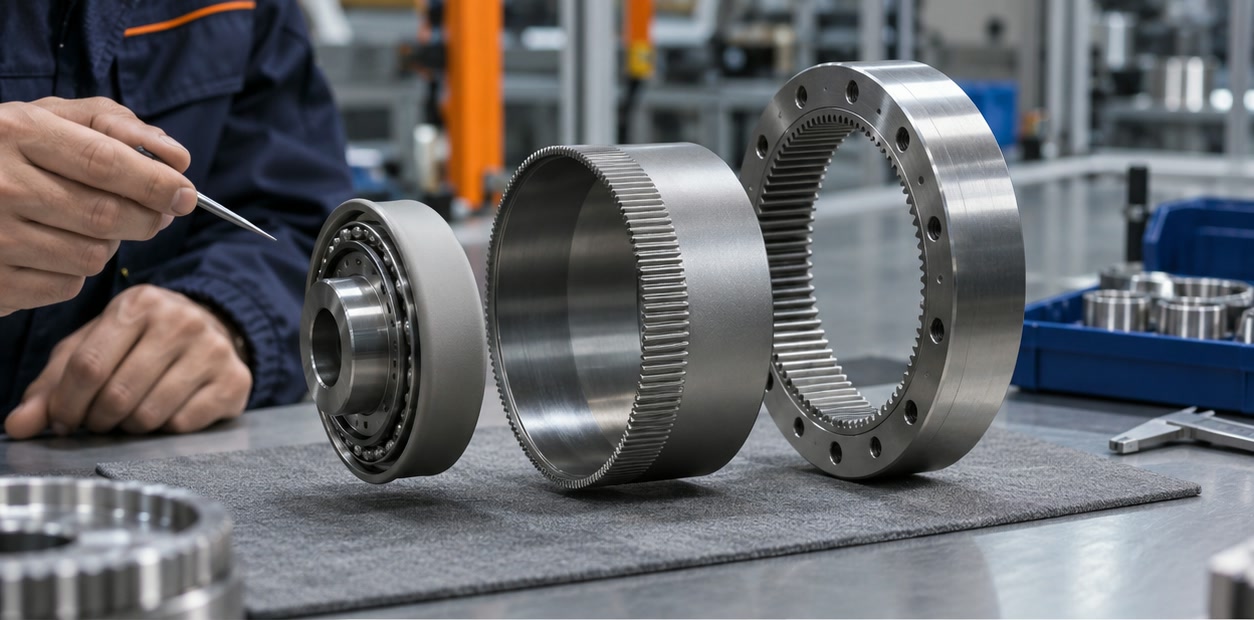
Why robot designers use strain-wave reducers
A strain-wave reducer can combine high reduction in one stage with a short axial length. Some designs also provide a hollow centre for cables or compact robot-joint layouts. These characteristics make the technology useful in robot joints, positioning equipment and other motion systems.
Performance depends on the specific reducer, mounting, load and test method. A low backlash statement does not by itself describe loaded hysteresis, output stiffness, positioning error, efficiency or lifetime. The assembled robot’s behavior also depends on its structure, bearings, motor, encoder, controller and calibration.
- Compact gearing and high reduction in a single mechanism
- Potentially useful output torque and positioning behavior in a small envelope
- Component-level properties must be checked against the complete joint and application
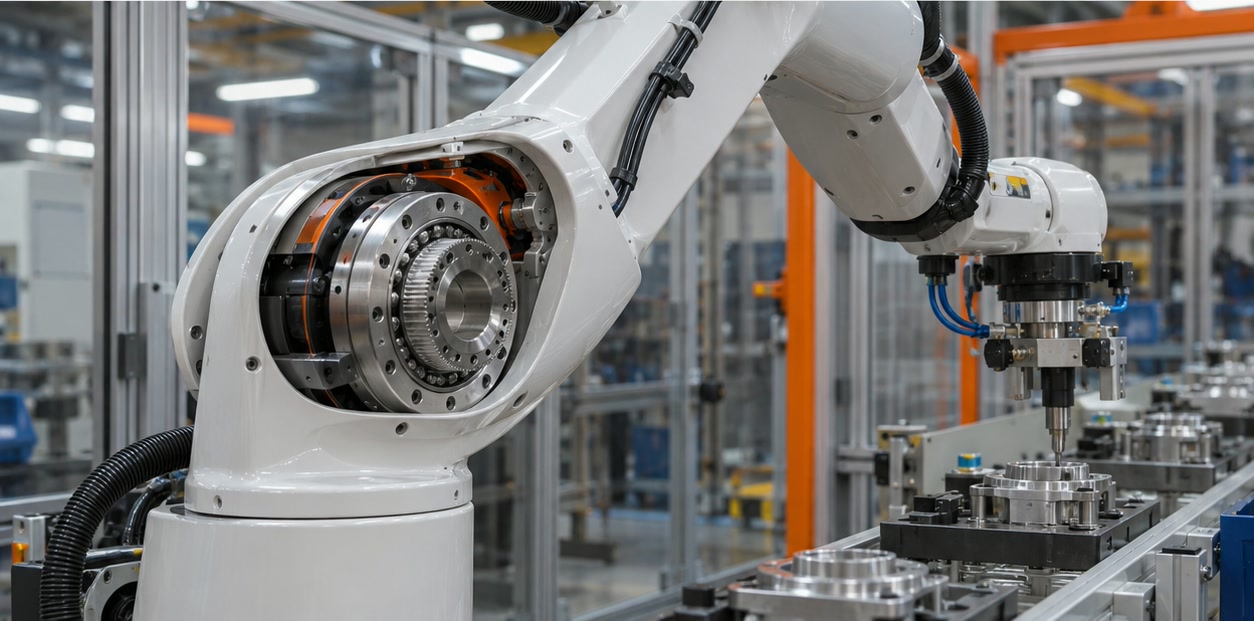
Where to look beyond the mechanism name
Strain-wave gears are not interchangeable solely because the housing diameter or ratio looks similar. A component set, a housed reducer and an integrated actuator are different supply configurations. Their datasheets may specify different interfaces, bearings, allowable loads and test conditions.
Before selecting a unit, match its torque and speed limits to the actual motion profile. Also check output loads, stiffness, life assumptions, lubrication, operating temperature, mounting tolerances and service requirements.
- Confirm whether the quoted item is a gear component set, housed reducer or complete joint
- Read torque, speed, stiffness and lifetime definitions in the current manual
- Check mounting, lubrication and allowable radial, axial and moment loads
What are the three parts of a harmonic drive?
A typical strain-wave gear has a wave generator, a flexspline and a circular spline. Their deformation and tooth-count difference create the speed-reduction effect.
Are all strain-wave reducers backlash-free?
Some manufacturer literature describes particular products as having zero or very low backlash under a defined meaning. Buyers should also check the measurement method, hysteresis, torsional stiffness, coupling and complete joint behavior.
Sources and further reading
- Harmonic Drive LLC — Operating principles — Manufacturer explanation of the wave generator, flexspline and circular spline mechanism.
- Harmonic Drive LLC — General product catalogue — Manufacturer catalogue describing strain-wave gearing components and characteristics.
- Leaderdrive — Product categories — Example of a manufacturer catalogue that distinguishes strain-wave gears and rotary actuators.
Technical descriptions link to published sources. Specifications can change; verify the current documentation before purchase.