
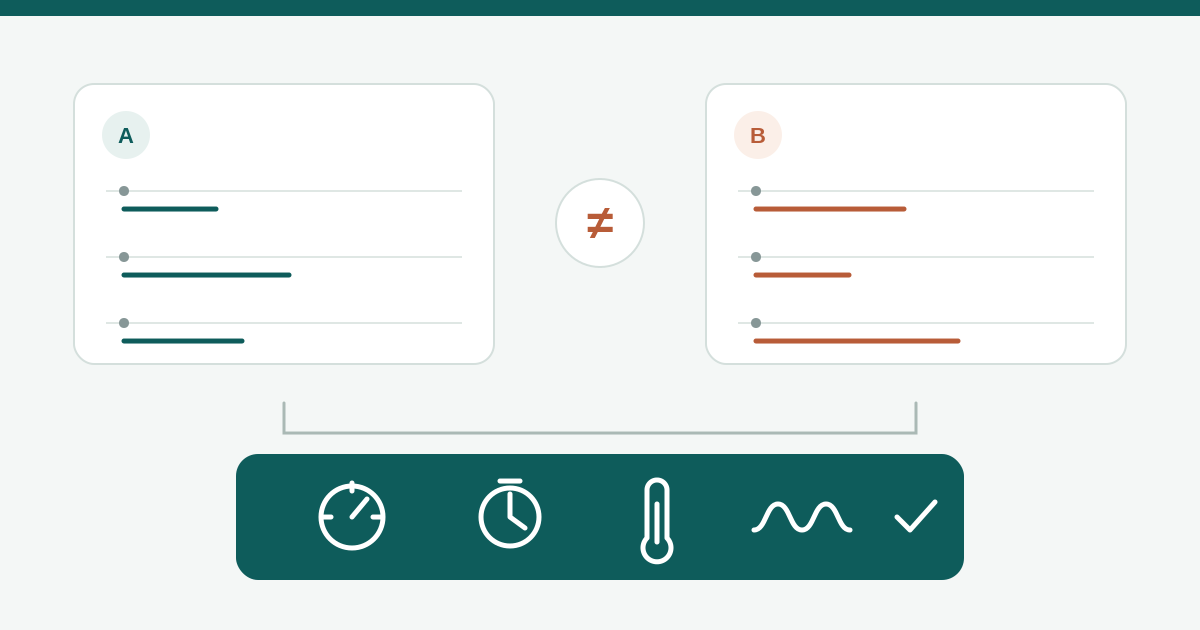
Comparing two humanoid robot joint datasheets side by side is one of the fastest ways to make a bad sourcing decision. An integrated joint packs a motor, reducer, encoder, drive electronics and often a brake into one compact housing—which means a single headline number on a brochure can hide very different measurement points, cooling setups and duty cycles.
Catalogues are still useful for building a shortlist. Just don’t use them to pick a winner. Until two suppliers report performance under the same operating conditions, their numbers are not on the same scale.
Why one torque number rarely tells the full story
In procurement conversations, rated, continuous and peak torque get tossed around as if they were standardized labels. They aren’t. Unless both suppliers define them at the same output shaft, output speed, ambient temperature and duty cycle, the figures are not directly comparable.
Here is where buyers most often get tripped up:
- Peak vs. continuous torque: Peak torque describes a short burst—catching a stumble or lifting a transient load. Without knowing how many seconds the joint can hold that burst, at what speed and how long it must cool down afterward, a peak figure is not a usable overload rating. Continuous torque, by contrast, is a thermal problem: how much load the joint can sustain without overheating inside its real mounting and cooling path.
- Motor shaft vs. output shaft: A motor-side figure ignores reducer losses and tells you nothing about what the joint actually delivers to the limb.
- Torque density (N·m/kg): This popular ratio is easy to inflate on paper. Dividing peak torque by bare motor weight produces a much flashier number than dividing continuous torque by the complete module mass (reducer, housing, encoder, brake and drive electronics). Always check both the numerator and the denominator.
Before putting two quotes in the same spreadsheet, ask for the exact part number and revision, confirmation that torque is measured at the output shaft, a full torque-speed curve and the test conditions behind each rating. If a supplier cannot provide those, log the number as an unverified brochure claim rather than a confirmed spec.
Twelve specs to normalize before comparing quotes
Static details—such as part revision, connector type, protocol version, encoder placement and brake configuration—can be lined up once you confirm you are looking at the exact same build. Performance numbers require a shared test basis. Having the same unit (N·m, arcmin, %) does not mean the suppliers ran the same test.
| Specification | What to align before comparing | Why it matters in practice |
|---|---|---|
| Rated or continuous torque (N·m) | Output shaft, supplier definition, speed, duty cycle, ambient temperature and thermal limit | Sets what the joint can carry all day. A motor-shaft figure is not delivered joint torque. |
| Peak torque (N·m) | Output speed, burst duration, repeat count, cool-down pause, direction, current limit and starting temperature | Sizes short, high-load moments. A peak number without a duration is not an engineering spec. |
| Torque density (N·m/kg) | Whether torque is peak or continuous, and exactly which parts are weighed | Meaningful only when both suppliers use the same numerator and the same mass boundary. |
| Reduction ratio | Input-to-output speed ratio, gear type and number of stages | Shapes speed and reflected dynamics, but the ratio alone does not prove output performance. |
| Backlash or lost motion (arcmin or arcsec) | Applied load, direction, temperature, measurement point and test method | Determines how cleanly the joint reverses and holds position. Do not conflate backlash with elastic deflection or repeatability. |
| Reflected inertia (kg·m²) | Reference shaft and which components (motor, reducer, etc.) are included | Governs how agile, backdrivable and controllable the joint feels. Ask for output-side figures or the calculation basis. |
| Efficiency (%) | Torque, speed, direction and temperature; reducer-only vs. complete module | Drives heat buildup, power draw and battery sizing. One best-case percentage is not an operating map. |
| Weight (kg) | Motor, reducer, encoder, brake, drive electronics, cables and cooling hardware—or an explicit list of exclusions | Adds up quickly across 20+ joints and increases the load on neighboring actuators. |
| Communication interface | Exact CAN, CAN FD or EtherCAT version, device profile, update/sync rates, connector and firmware | Decides whether the module drops cleanly into your controller and real-time control loop. |
| Encoder | Motor-side or output-side; absolute or incremental; resolution, accuracy, latency and single vs. dual setup | High resolution does not guarantee accuracy. An output-side encoder catches transmission error that a motor-side sensor cannot see directly. |
| Brake | Holding torque, power-off state, release time, voltage and dynamic-braking rating | Critical for holding a robot’s posture safely when power drops and for your system safety case. |
| Ingress protection | IP rating and exact tested assembly, including housing seams and connectors | A bare-component rating often does not survive real-world cable glands and joint seals. |
The test conditions you should actually ask for
Whenever a supplier quotes a torque, efficiency or thermal figure, ask what happened on the test bench:
- Thermal setup: Ambient temperature, mounting orientation, heat-sink contact, airflow or liquid-cooling flow rate, and whether the joint ran inside its intended housing.
- Operating profile: Load and speed profile, duty cycle, test duration, direction reversals and whether the unit actually reached thermal equilibrium.
- Control limits: Where temperature sensors sit, their cutoff thresholds, current and voltage limits, firmware version, and how the drive derates or shuts down under heat.
- Peak-torque protocol: Exact burst duration, number of repeats, recovery interval, output speed and permitted temperature rise.
- Traceability: Test method or standard used, measurement point, instrument calibration status, sample serial number and report date.
- Full envelope, not one point: A torque-speed curve and thermal log across your real working range, not a single best-case number.
Just as important is who ran the test. A supplier’s internal bench report, an accredited third-party lab report and your own incoming acceptance test each answer a different question—keep them clearly labeled in your evaluation.
Harmonic, QDD or planetary: treat architecture as a starting point, not a verdict
Transmission labels are handy shorthand for narrowing down what questions to ask, but they never replace measured data:
- Strain-wave (harmonic) reducers are often the first stop when space is tight and low backlash is a priority. Harmonic Drive’s catalogue, for instance, describes specific product families as zero-backlash and publishes their reduction ratios. Keep in mind that is a manufacturer statement about those specific product lines—not a blanket guarantee for every strain-wave joint on the market. Always verify loaded lost motion, torsional stiffness, efficiency across your speed range, thermal limits and service life.
- Quasi-direct drive (QDD) is an actuator design philosophy pairing a high-torque-density motor with a low-ratio transmission. Peer-reviewed studies (such as Yu et al. and Zhu et al.) have measured strong backdrivability and bandwidth on specific experimental QDD exoskeleton actuators—useful engineering references, not certifications for a commercial humanoid joint.
- Planetary vs. QDD is not an either/or choice: “Planetary” describes a gear geometry, while “QDD” describes an overall actuator approach, so many QDD joints use planetary stages. Neither label by itself proves shock tolerance, continuous torque or fitness for a hip, knee or arm.
Start from your robot’s real torque-speed envelope, duty cycle, packaging space, thermal path and control loop—then let bench data decide which architecture wins.
How to read the sources behind this guide
To keep evidence boundaries clear: the Harmonic Drive catalogue cited below is a manufacturer statement about named gearhead series; the two IEEE/ASME QDD papers are independent academic studies of specific exoskeleton actuators; and the normalization table and sourcing checklists in this article are RoboPallas editorial analysis. None of these sources is a head-to-head lab benchmark of commercial modules listed in our supplier directory.
What China’s SJ/T 12356—2026 standard means for joint buyers
In November 2026, China’s Ministry of Industry and Information Technology (MIIT) approved SJ/T 12356—2026, a recommended electronics-industry standard for motor-driven integrated joints in humanoid robots. According to MIIT’s official Annex 1, it covers appearance and structure, interfaces, performance, safety, electromagnetic compatibility and matching test methods, taking effect from publication. One crucial scope boundary: it explicitly excludes the small joints used in dexterous hands, though other robot joints may use it as a reference.
For buyers, the practical takeaway is simple: SJ/T 12356—2026 is a recommended Chinese industry standard, not a mandatory national law or a standalone certification. Because RoboPallas has reviewed the official announcement and annex summary—but not the full published text—we cannot verify its exact pass/fail thresholds or test fixtures from the summary alone. If a supplier cites SJ/T 12356—2026, ask which edition and clauses they tested against and request the underlying reports. For a deeper breakdown of all five MIIT standards, see our companion Insights piece: https://robopallas.com/insights/miit-five-humanoid-robot-industry-standards-2026/
Your pre-quote RFQ checklist
Before comparing final pricing, ask every shortlisted supplier for:
- A signed, model-specific datasheet with revision number, clear rating definitions and a complete torque-speed curve.
- A dynamometer report specifying output measurement point, fixture, load profile, test conditions, sample serial number and instrument calibration.
- Thermal test logs under your intended mounting and cooling setup, including sensor placement, temperature limits and derating behavior.
- A 3D CAD model, dimensioned drawing, complete module mass and an explicit list of included vs. excluded accessories.
- Interface documentation: protocol and profile, message map, timing/sync specs, firmware version, encoder data and fault handling.
- Brake specifications plus evidence backing any holding-torque or safety claims.
- A production-lot consistency statement covering sampling plans, key measured parameters and engineering change notifications (PCN).
- If
SJ/T 12356—2026is cited, the exact clauses, edition and supporting test records.
Match those records directly against your robot’s duty cycle. Confirm that torque is measured at the output, thermal boundaries reflect your housing, peak duration is spelled out and module weight counts the same hardware. Keep brochure claims separate from measured evidence—and write any unanswered requirement straight into your purchase specification or acceptance test.
Related sourcing resources
- Harmonic reducer datasheet guide: https://robopallas.com/guides/read-harmonic-reducer-datasheet/
- Robot specification sheet guide: https://robopallas.com/guides/robot-specification-sheet-guide/
- Robot supplier documents checklist: https://robopallas.com/guides/robot-supplier-documents/
To discover suppliers, browse our Joint modules & actuators directory: https://robopallas.com/suppliers/#component=joint-modules. Listing in the directory is for discovery only and is not an endorsement, recommendation or certification.
Unknowns and limits
- The complete text of
SJ/T 12356—2026was not available for this review, so its detailed numeric thresholds, fixtures and test procedures remain unverified. - RoboPallas has not run an independent, same-fixture comparison of commercial humanoid joint modules. This article does not rank or recommend suppliers.
- The cited QDD studies test specific exoskeleton actuators, not directory-listed commercial modules or every humanoid duty cycle.
- All supplier claims regarding torque, efficiency, service life, lot consistency, lead times and after-sales support must be verified against current signed documents and physical samples.
Sources
- MIIT, Announcement No. 30 of 2026, dated 10 November and posted 16 November 2026; Annex 1, item 121: https://www.miit.gov.cn/zwgk/zcwj/wjfb/gg/art/2026/art_eb2325cb1a844fe99958eb8d104a34fc.html and https://www.miit.gov.cn/cms_files/filemanager/1226211233/attach/202611/6d2b9d84f80c435fb9c2feff84529863.pdf
- RoboPallas, “MIIT publishes five recommended Chinese industry standards for humanoid robots,” 19 November 2026: https://robopallas.com/insights/miit-five-humanoid-robot-industry-standards-2026/
- Standardization Law of the People’s Republic of China, Article 2, and Measures for the Administration of Industry Standards (SAMR Order No. 86, 2023): https://www.samr.gov.cn/zw/zfxxgk/fdzdgknr/fgs/art/2023/art_d7040b9f1d0f4980a0e55089a57bf37d.html and https://www.samr.gov.cn/zw/zfxxgk/fdzdgknr/fgs/art/2023/art_ebd7a79783c24f2cad31f29a8b0c0931.html
- Harmonic Drive LLC, HarmonicDrive Gearhead Series catalogue, undated; accessed 22 November 2026: https://www.harmonicdrive.net/apps/downloaddocument?path=%2F_hd%2Fcontent%2Fdocuments%2Fgearhead-catalog.pdf
- Shuangyue Yu et al., “Quasi-Direct Drive Actuation for a Lightweight Hip Exoskeleton with High Backdrivability and High Bandwidth,” IEEE/ASME Transactions on Mechatronics, 25(4), 1794–1802, published 18 May 2020: https://doi.org/10.1109/TMECH.2020.2995134
- Hanqi Zhu et al., “Design Principles for Compact, Backdrivable Actuation in Partial-Assist Powered Knee Orthoses,” IEEE/ASME Transactions on Mechatronics, 26(6), 3104–3115; published online 20 January 2021: https://doi.org/10.1109/TMECH.2021.3053226