
The short answer
An industrial robot is classified by its intended use in industrial automation and its technical definition. A collaborative robot, often called a cobot, is designed for applications where people and robots may work in proximity. These labels describe different things: one concerns the robot’s industrial role, while the other concerns collaborative use and the system around it.
A cobot is not a guarantee that a finished cell can run without guarding. The task, end effector, workpiece, layout, motion and nearby people all affect the application’s risk. The robot model is one part of that assessment.
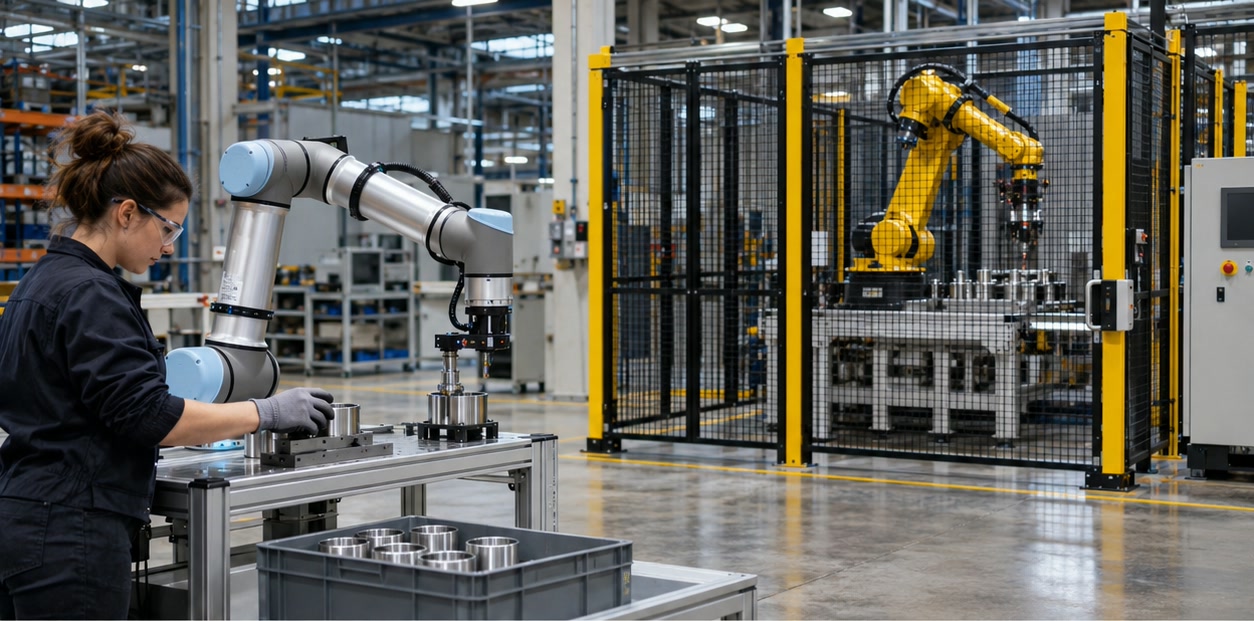
What changes in the workcell
Traditional industrial cells often separate people from robot motion with guards, scanners or controlled access. Collaborative applications can use other arrangements, such as speed and separation monitoring or power and force limiting, when the complete design supports them. The correct measures depend on the actual process and the applicable standards in the installation market.
A slow arm can still create a hazard if it carries a sharp tool, traps a hand against a fixture or moves a heavy workpiece. A collaborative robot used with an unsuitable tool or layout may therefore need additional protective measures. Assess the whole application before selecting the robot.
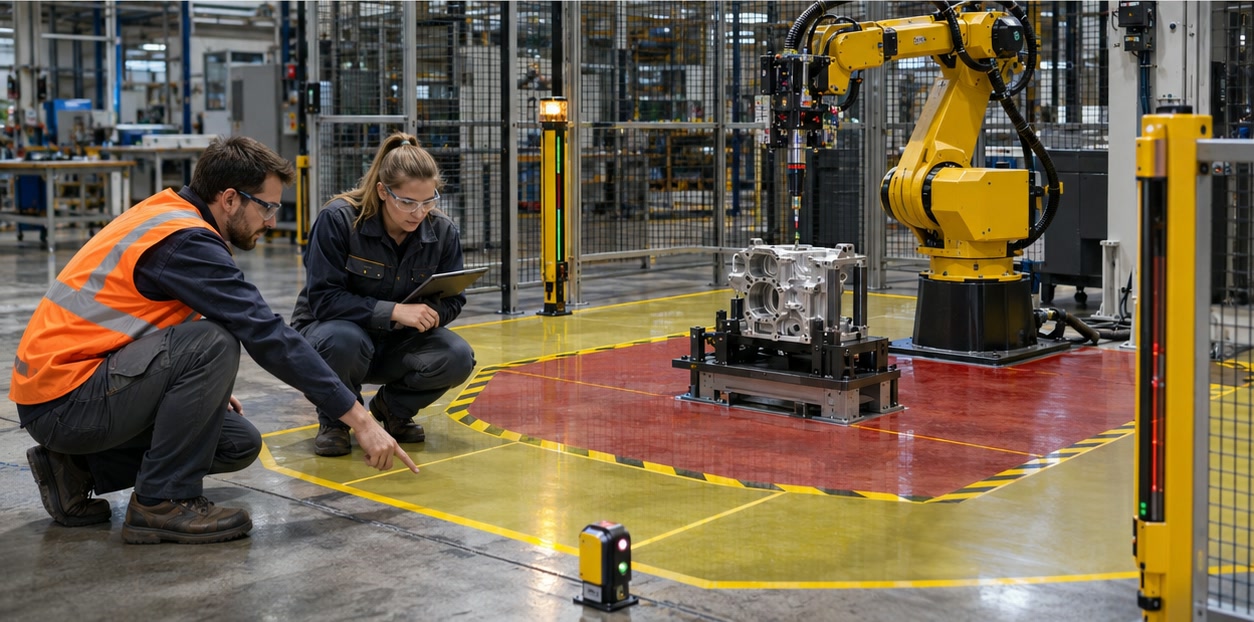
Questions to ask before choosing
Start with the task and the people who will share the area. Define the required cycle, payload, reach, tooling, production variation and access pattern. Then ask an integrator to document the risk assessment and the proposed safeguards for the completed cell.
Compare system requirements rather than the label on the arm: programming and recovery, floor space, safety components, changeover, integration effort and local service can shape the project more than the category name.
- What is the tool and workpiece, including sharp edges or pinch points?
- Will people remain beside the robot, enter the area intermittently or work in a separate cell?
- Which safeguards and safety functions are required for this exact task?
Is every collaborative robot safe to use without a fence?
No blanket conclusion follows from the product label. The complete robot application needs a risk assessment, and the result determines whether guarding or other protective measures are needed.
Are cobots industrial robots?
Many cobots are collaborative industrial robots. The term cobot describes collaborative use; the robot’s classification and the application still depend on the applicable definitions and context.
Sources and further reading
- International Federation of Robotics: Industrial Robots — Definitions and robot classifications.
- International Federation of Robotics: Collaborative Robots — Collaborative use and application context.
- ISO 10218-2:2025 — Industrial robot applications and robot cells.
Technical descriptions link to published sources. Specifications can change; verify the current documentation before purchase.