Robot type describes the mechanism
Industrial robot categories often refer to the arm’s kinematic structure: how its links and joints create motion. The International Federation of Robotics lists articulated, Cartesian, cylindrical, polar, SCARA and parallel or Delta structures. A robot’s structure affects its workspace and motion, but it does not by itself tell you whether a model fits a particular production task.
Catalog names can vary between manufacturers. When a supplier uses a broad label, check the drawing, axis arrangement, mounting orientation and usable work envelope for the exact model.
Common structures in plain language
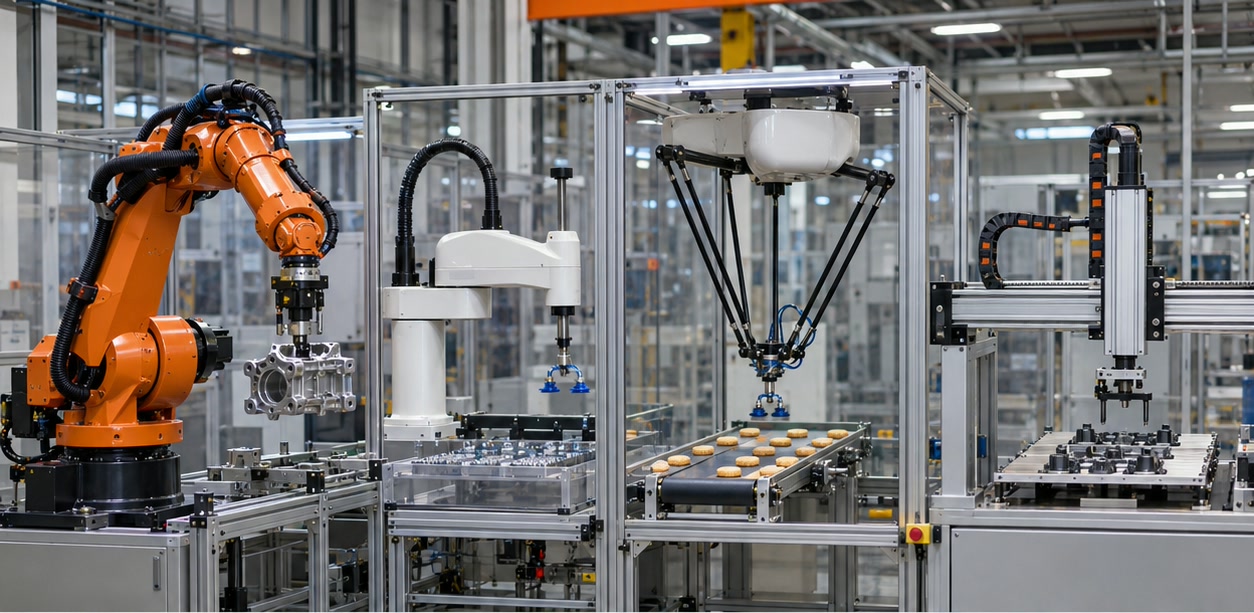
An articulated arm uses several rotary joints and can reach around fixtures in a flexible workspace. A Cartesian or gantry system moves along linear axes, often creating a rectangular work envelope. A SCARA robot uses a particular joint arrangement that supports fast motion in a plane with vertical movement. A parallel or Delta robot connects multiple arms to a shared moving platform and is often used where high-speed pick-and-place is required.
These are structural descriptions, not performance rankings. Payload, speed, accuracy, stiffness, footprint and integration requirements vary widely within every structure.
Match the structure to the task
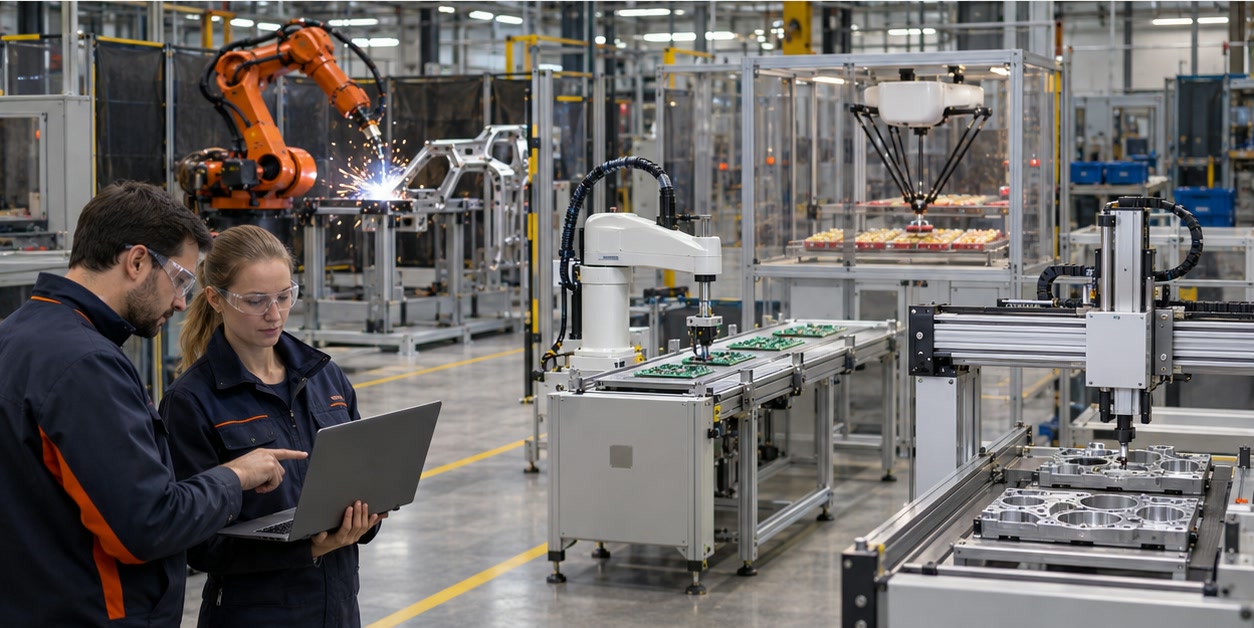
Map the required tool path and access points before looking at product families. A machine-tending path around a door and a high-speed transfer between two conveyor lanes create different workspace needs. Include the tool, part, fixture, safety equipment and maintenance access in the layout.
Ask suppliers for the reach diagram and mounting conditions, then confirm the planned path with an integrator. A simple cell drawing can expose blind areas, reach limits and interference before a model is selected.
- Where are the pick, place and process points?
- Does the robot need to reach around or through a fixture?
- How much floor or overhead space is available for the robot and its service access?
Which industrial robot type is the most flexible?
Flexibility depends on the task, layout, tooling and control system. Articulated arms offer a wide range of motion, while other structures can fit specific paths or cell layouts well. Define the application before choosing by type.
Is a SCARA robot a collaborative robot?
SCARA describes a mechanical structure. Collaborative use is a separate question about the robot and the designed application.
Sources and further reading
- International Federation of Robotics: Industrial Robots — Definitions of common industrial robot structures.
- International Federation of Robotics: Robot History — Background on SCARA and Delta mechanisms.
Technical descriptions link to published sources. Specifications can change; verify the current documentation before purchase.