
Vacuum gripping holds a part through a pressure difference
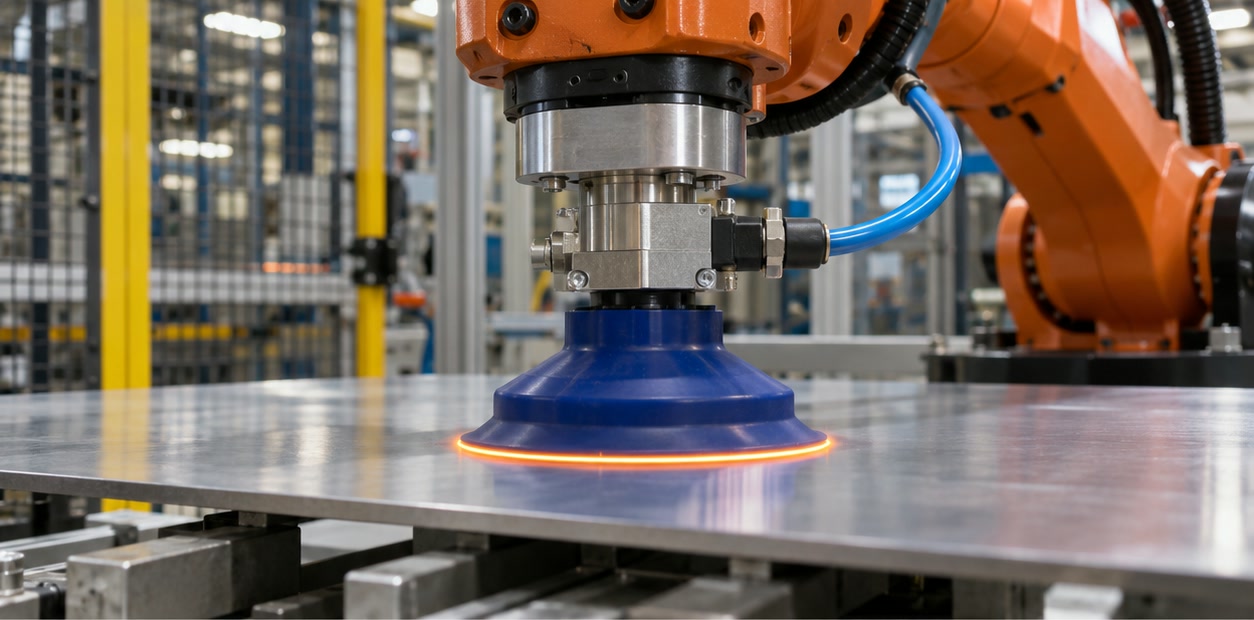
A vacuum gripper uses one or more suction cups or a larger-area foam surface to create a pressure difference between the tool and the workpiece. The holding force depends on the effective sealed area and the pressure difference, but the practical result also depends on leakage, surface quality, orientation and robot acceleration.
A cup that seals well on a smooth sheet may perform differently on a porous carton, rough casting, oily panel or curved surface. Start with real workpieces and choose cup shape and material for the surface and temperature.
- Flat cups for relatively even surfaces
- Bellows cups to accommodate height or angle variation
- Foam or multi-zone tools for larger areas or mixed surfaces
Select the vacuum source and layout
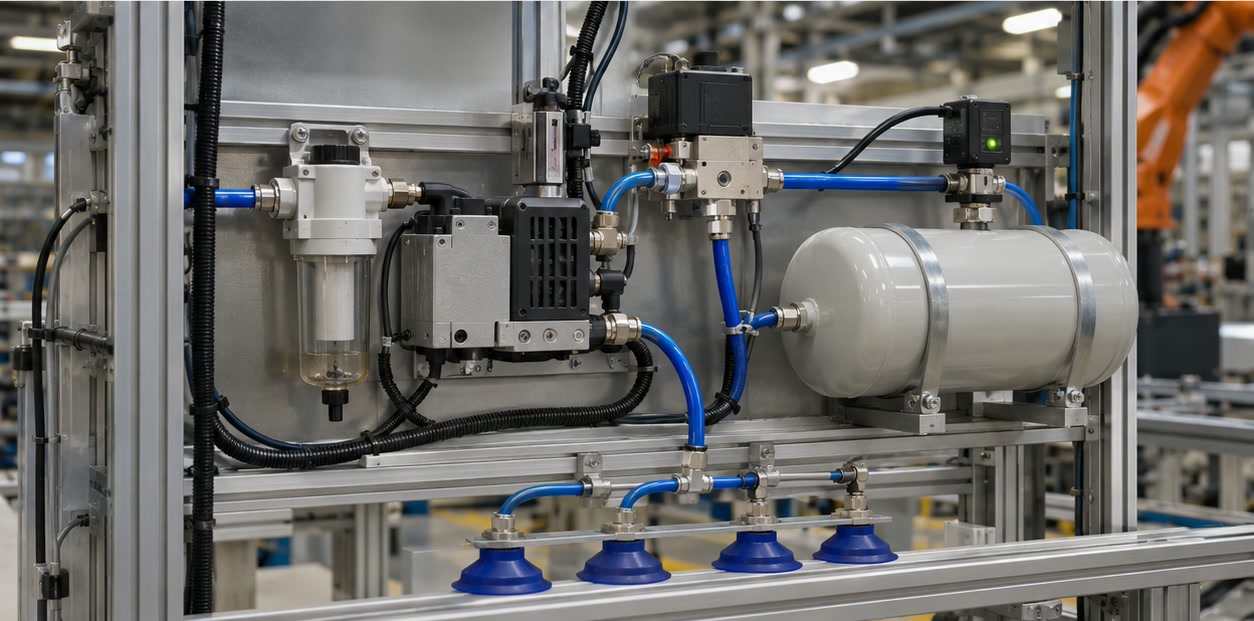
Vacuum can be generated by a compressed-air ejector or by an electric pump. An ejector can be compact and respond quickly; a pump may suit other flow, energy or system arrangements. The right choice depends on leakage, cycle time, available utilities, noise and maintenance needs.
Multiple cups can distribute load and improve stability, but only if their positions support the part through its centre of gravity and motion. Include a vacuum reservoir or other retention measure where required by the risk and process assessment.
- Cup diameter, shape, material and number of contact points
- Ejector or pump flow matched to expected leakage
- Vacuum switch, pressure monitoring, blow-off and retention design
Test dynamic loads and failure cases
The ideal holding force calculation does not capture every real condition. Check lifting direction, horizontal motion, rotation, acceleration, cup spacing, leaks and the consequences of a dropped part. Use an application-specific safety margin and follow the manufacturer’s sizing method.
Test the least favorable workpiece and surface condition, not only a clean sample. Confirm that the controller can detect a failed pickup, that release is controlled and that the tool can be maintained safely.
- Representative part mass, centre of gravity and acceleration
- Porosity, roughness, curvature, dust, oil and surface variation
- Grip monitoring, drop prevention, release timing and recovery logic
What materials can a robot vacuum gripper pick up?
Vacuum gripping can handle materials whose surface can maintain a suitable seal or be supported by an appropriate foam or multi-cup tool. Porosity, roughness, curvature, dust, oil and surface variation must be tested for the actual part.
How many suction cups does a robot vacuum tool need?
The number and layout depend on part geometry, mass, centre of gravity, cup capacity, surface leakage and robot motion. Follow the manufacturer’s sizing method and validate the arrangement using representative parts.
Sources and further reading
- Festo — Basic principles of vacuum technology — Selection guidance covering workpiece surface, suction cups, load and holding forces.
- Festo — Robot gripper selection in five steps — Application guidance on vacuum and mechanical gripping concepts.
Technical descriptions link to published sources. Specifications can change; verify the current documentation before purchase.