
The end effector is the robot’s process interface
An end effector is the device fitted to a robot’s tool flange to interact with a part or process. It can grip, hold, rotate, weld, dispense, inspect, deburr or perform another task. In a complete workcell, it connects the robot’s motion to the actual process.
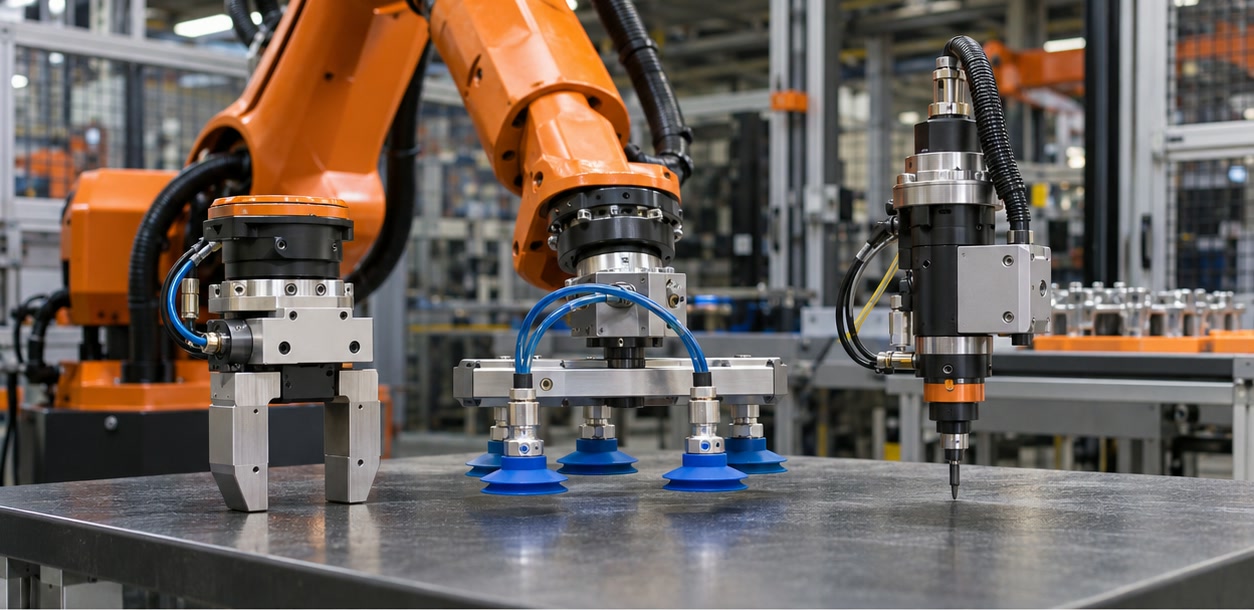
A gripper is one kind of end effector. Other examples include a vacuum tool, magnetic pickup, welding torch, screwdriver, dispensing head, sanding spindle or tool changer. A single application may combine several functions or use an automatic changer to switch tools.
- Mechanical grippers use fingers or jaws to hold a part
- Vacuum tools use cups or foam to create a pressure difference across a surface
- Magnetic tools hold suitable ferrous parts
- Process tools perform work such as welding, fastening, polishing or dispensing
Choose a gripping concept around the workpiece
Start with the part geometry, material, surface, mass, temperature and variation. A parallel gripper can suit parts with accessible edges or gripping faces; a three-finger or adaptive design may accommodate other geometries. Vacuum can suit flat or delicate surfaces when a reliable seal is possible, while magnetic gripping is limited to compatible materials.
Robot acceleration and orientation change the forces on the part. The contact shape, finger length, cup spacing, friction, leakage, compliance and sensing all affect whether the workpiece remains secure. Validate the concept using representative parts and realistic motion.
- Where the tool can contact the part and what marks are permitted
- Part tolerances, surface condition, oil, dust, porosity and temperature
- Grip confirmation, part-present sensing, release and recovery behavior
Check interfaces, utilities and maintenance
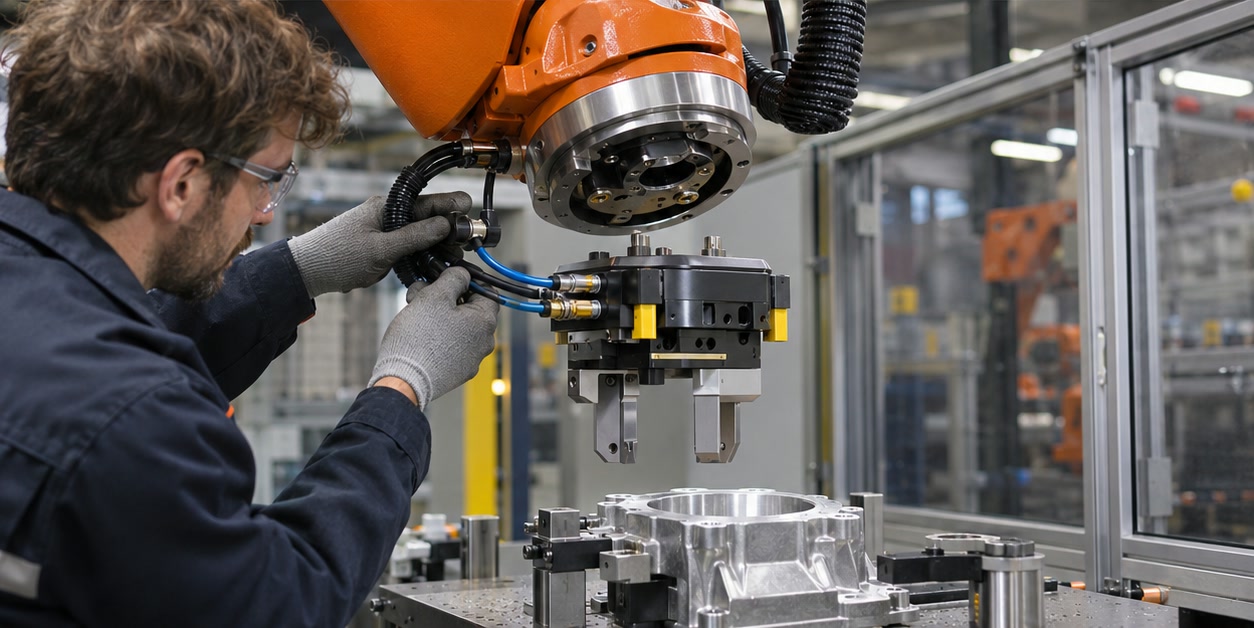
The tool must fit the robot mechanically and electrically, and it may also need compressed air, vacuum, data or safety signals. Confirm flange pattern, tool centre point, total mass, centre of gravity, inertia, cables and hose routing against the robot’s limits.
Document the tool setup so it can be serviced and repeated. For changeovers, include the tool changer, calibration, stored offsets and safe management of air or electrical energy.
- Mounting, payload, wrist moments and centre-of-gravity limits
- Power, I/O, communication, pneumatic or vacuum connections
- Fingers or cups, wear parts, setup instructions and validated backups
What is a robot end effector?
It is a device attached to the robot’s tool flange to interact with a part or process. Grippers, vacuum tools, welding torches and dispensing heads are common examples.
Is a robot gripper the same as an end effector?
A gripper is one type of end effector. The end-effector category also includes process tools and other devices mounted at the end of the robot arm.
Sources and further reading
- Festo — Gripper product categories — Examples of pneumatic and electric gripper types and common specification terms.
- Festo — Robot gripper selection in five steps — Application-led guidance on gripping concepts and validation.
Technical descriptions link to published sources. Specifications can change; verify the current documentation before purchase.