
AGV and AMR are industry labels with overlapping usage
AGV commonly refers to an automated guided vehicle that follows a defined route, such as a wire, marker, reflector or mapped path. AMR commonly refers to an autonomous mobile robot that senses its environment and plans or adjusts its route around obstacles. These descriptions are useful shorthand, but naming is not consistent across every supplier or product.
ISO 3691-4:2023 uses the broader term driverless industrial truck and gives both automated guided vehicles and autonomous mobile robots as examples. It focuses on the vehicle and system safety requirements, not on a marketing boundary between the two names. A third edition is under development, so check the current standard status for a project.
- AGV: often associated with a more predefined route or guidance infrastructure
- AMR: often associated with onboard sensing and route adjustment
- Check the actual navigation, load handling and safety functions rather than the label
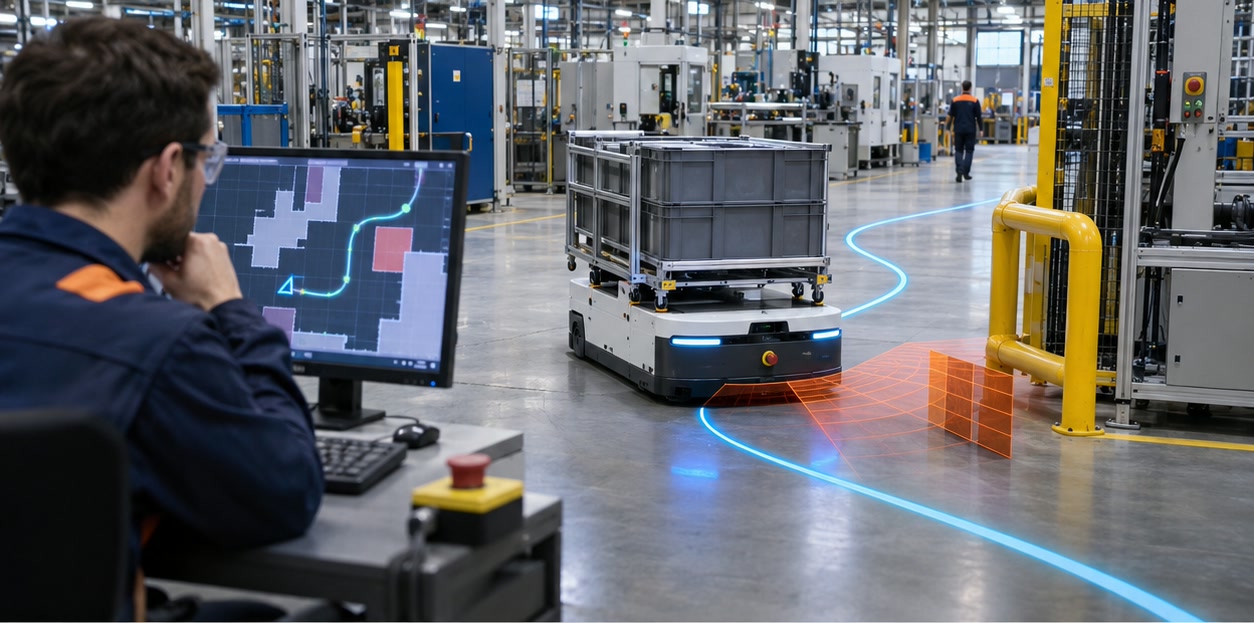
Compare the operating design, not the acronym
For a factory project, find out how the vehicle localizes, plans a route, detects people and obstacles, handles a blocked aisle and returns to service after a stop. Also ask whether traffic management, fleet scheduling, doors, lifts, conveyors and charging equipment are part of the system.
The same acronym can describe different technical approaches. Request a site demonstration or route trial that includes the actual floor, aisle width, intersections, loads, traffic and communication conditions.
- Navigation method, map creation and localization behavior
- Obstacle detection, speed zones, stop and restart behavior
- Fleet management and integration with doors, lifts and production systems
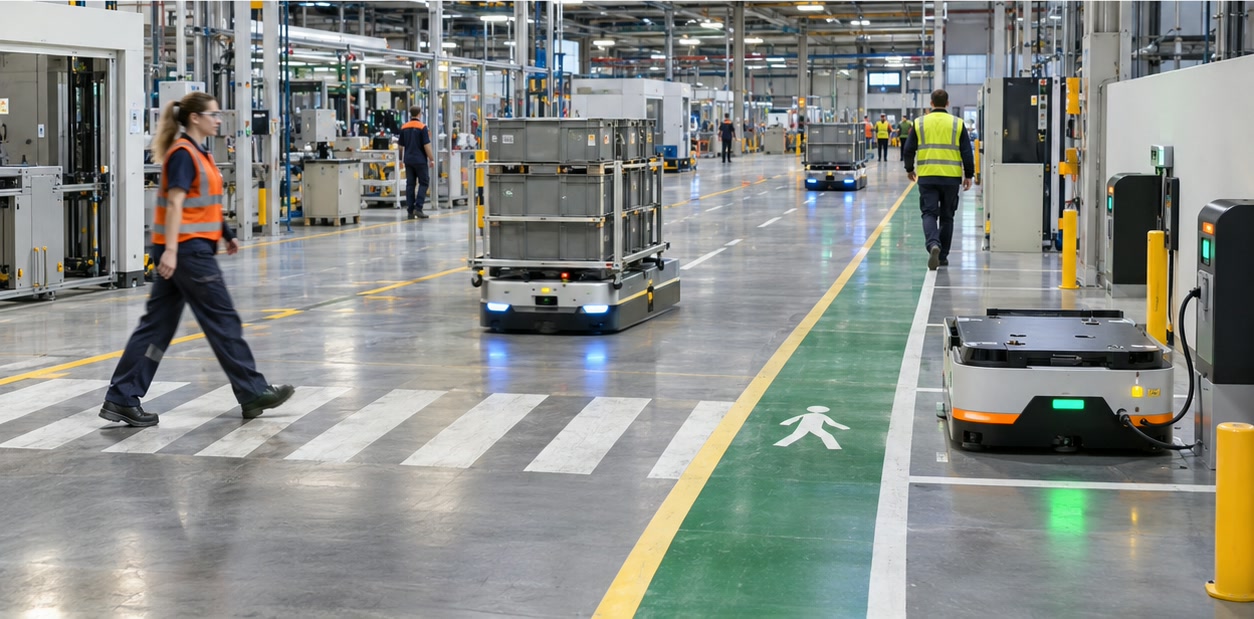
Safety depends on the vehicle and its operating zone
Mobile-robot safety depends on the complete vehicle, its load, routes, operating zone, people, fixed equipment and traffic rules. The route and work area must be prepared and hazards assessed for intended use. A label such as AMR does not mean that the vehicle can safely operate in every aisle or around every person.
ISO 3691-4:2023 is the published edition as of this guide’s update date; ISO lists a new edition under development. Confirm the applicable edition, national adoption and project requirements before using a standard as a compliance checklist.
- Pedestrian crossings, blind corners, doorways and shared work zones
- Load stability, stopping space, charging, maintenance and emergency response
- Site risk assessment and verification of the complete vehicle system
What is the difference between an AGV and an AMR?
In common industry usage, AGVs often follow more predefined routes while AMRs use onboard sensing to adjust routes. The terms are not applied uniformly. ISO 3691-4:2023 groups both as examples of driverless industrial trucks.
Are AMRs safer than AGVs?
The label alone does not establish safety. Safety depends on the vehicle’s functions, configuration, load, operating zone, traffic and risk controls for the complete system.
Sources and further reading
- ISO 3691-4:2023 — Driverless industrial trucks and their systems — Published safety standard that includes AGV and AMR as examples of driverless industrial trucks.
- ISO/DIS 3691-4 — Revision under development — Current ISO project page for the next edition; verify status before project use.
- IFR — Robot definitions — Terminology for mobile robots, mobile platforms and industrial applications.
Technical descriptions link to published sources. Specifications can change; verify the current documentation before purchase.