
A mobile manipulator combines a base and a robot arm
A mobile manipulator is a mobile platform carrying a robot arm and an end effector. The platform moves between locations; the arm reaches, grasps or operates at a workstation. The system also needs perception, localization, motion planning, power, communications and coordination between the base and arm.
Mobile manipulators can support tasks such as moving parts between stations, tending equipment or handling items across a larger area. Whether a task is feasible depends on the load, reach, stability, station interfaces, navigation and the grasping process, not simply on adding the arm’s payload to the base’s rating.
- Mobile base with navigation and obstacle-detection functions
- Robot arm, controller and end effector
- Sensors, computing, power and software that coordinate base and arm
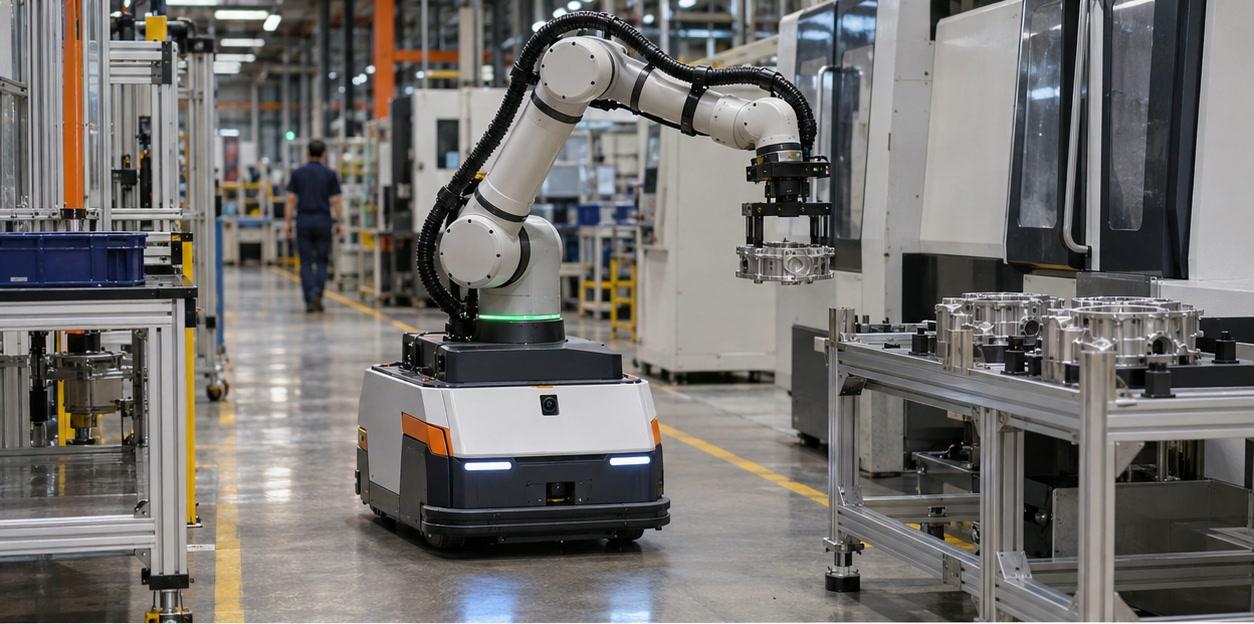
Coordinate two kinds of motion
The base and arm affect each other. A part that the arm can reach while the platform is stationary may become unreachable or unstable if the base is not positioned precisely. Moving the arm can shift the system’s centre of gravity; base movement can affect the arm’s reference frame and perception.
A project should define where the platform parks, how it aligns to the station, when the base is immobilized, how the arm moves and how handoffs occur. The system may need a docking feature, fiducial, station interface or other method to establish repeatable positioning.
- Base localization and docking repeatability
- Combined load, centre of gravity, stability and arm reach
- Sequence for base stop, arm operation, transfer and departure
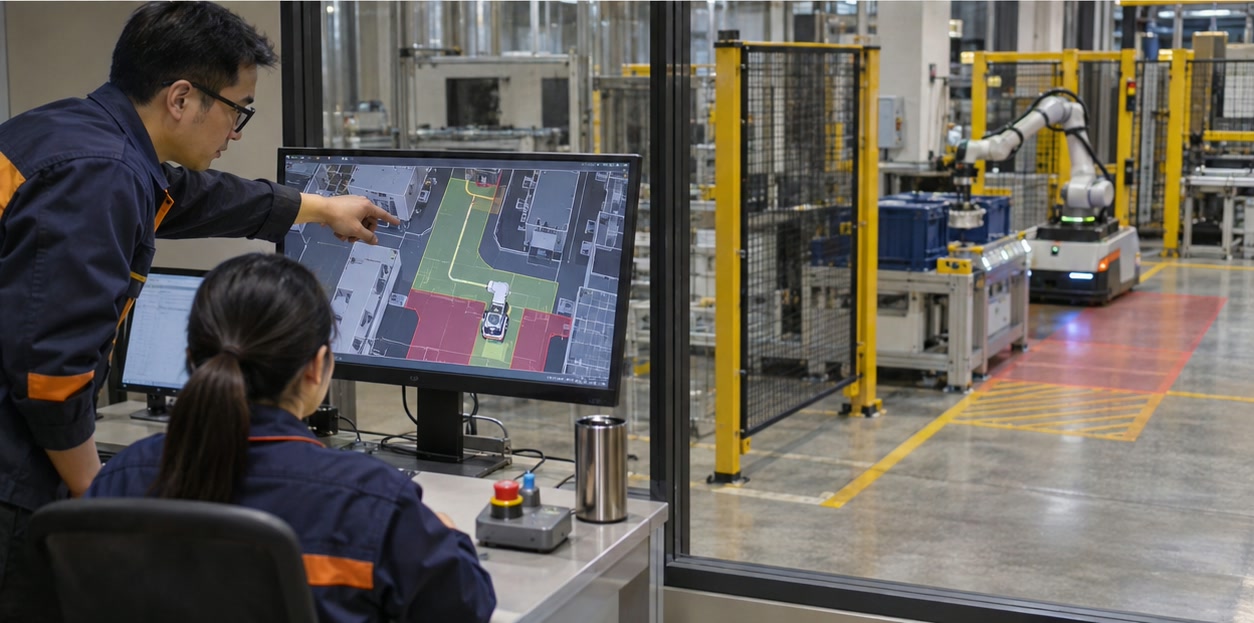
Treat integration and safety as a complete system
The platform, arm, tool, payload, workstation and operating zone form one application. Safety functions and risk controls must account for base motion, arm motion, people, load handling and the shared space. Clarify which supplier or integrator owns system-level design, validation and support.
Test representative routes and manipulation tasks together. Validate communication loss, unexpected obstacles, docking error, missed grasp, dropped-part response, power limits, charging and recovery. Confirm data access and maintenance responsibilities across the base and arm suppliers.
- System-level risk assessment and safety validation
- Joint tests for navigation, docking, manipulation and handoff
- Single owner for fault diagnosis, software versions and service escalation
What is a mobile manipulator robot?
It is a mobile robot platform carrying a manipulator, usually a robot arm and tool, that can move between locations and perform handling or process tasks.
Can a mobile manipulator reach as far as the robot arm’s full rated reach?
The arm’s reach describes its own workspace under defined conditions. The combined application also depends on platform position, docking accuracy, stability, payload, obstacles and the safety limits of the complete system.
Sources and further reading
- IFR — Robot definitions — Defines a mobile robot as a robot able to travel under its own control and notes platforms with or without manipulators.
- AgileX Robotics — Ranger Mini — Example manufacturer platform page within a catalogue that spans mobile robots and robotic arms.
- ISO 3691-4:2023 — Driverless industrial trucks and their systems — Safety requirements for driverless industrial trucks and their systems; application scope must be checked.
Technical descriptions link to published sources. Specifications can change; verify the current documentation before purchase.