
Repeatability is not the same as accuracy
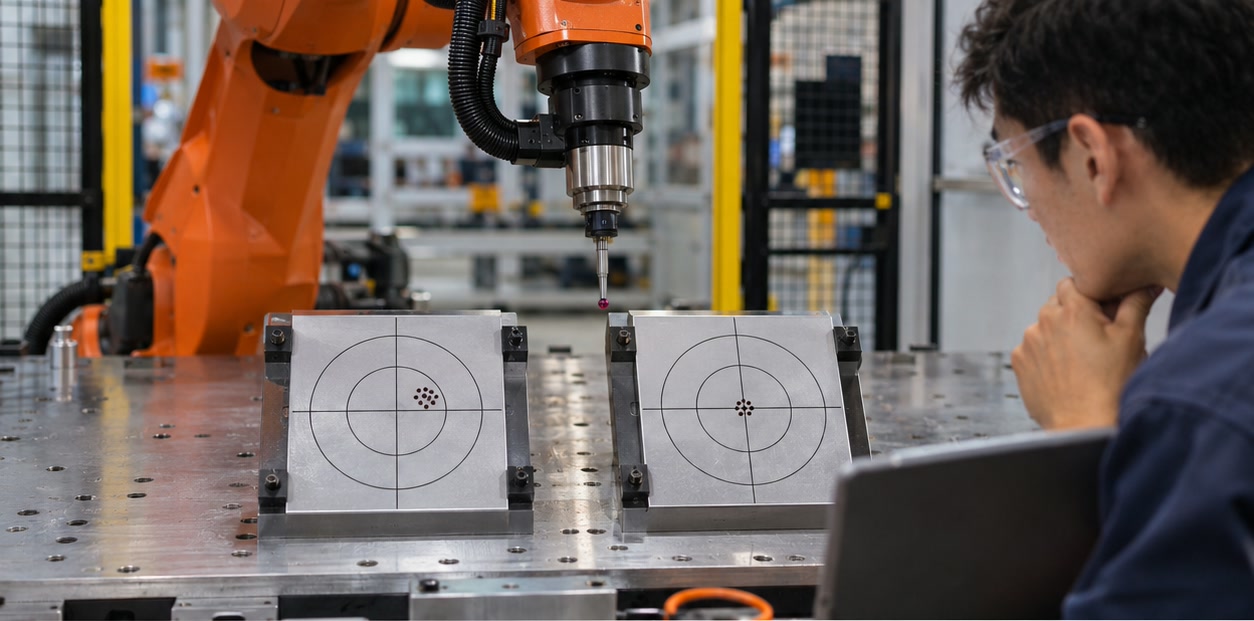
A robot can repeatedly return to nearly the same location while that location is offset from the intended target. Repeatability describes the consistency of repeated motion under specified conditions; accuracy concerns the difference between the achieved and target position. Both depend on how the measurement is defined and performed.
Manufacturers may list position repeatability, path repeatability or another performance measure. These are different quantities. Avoid treating one catalog figure as a universal measure of the completed cell’s process accuracy.
Why test conditions matter
Robot performance measurement depends on factors such as payload, speed, pose, warm-up, mounting and measurement procedure. The ISO 9283 standard covers performance criteria and test methods for manipulating industrial robots. Its full text is a standards document; the public catalog page identifies its scope and status.
A number without a named method or conditions is hard to interpret. Ask the supplier for the exact model’s manual, the test conditions behind the figure and the distinction between static position, path and process performance.

Connect the specification to the process
Define the tolerance needed at the workpiece and identify the measurement point: robot flange, tool center point or finished process result. The gripper, fixture, vision calibration, tool wear, temperature and workpiece variation all contribute to what the cell actually achieves.
For a critical task, validate the complete process with a representative tool and part. Store the acceptance method and measurement locations so a robot specification is not mistaken for a full-cell guarantee.
- Which repeatability or accuracy metric is stated?
- What load, speed, pose and warm-up conditions were used?
- Where will the process be measured, and against what tolerance?
Is robot repeatability the same as process accuracy?
No. Process accuracy also depends on tools, fixtures, calibration, parts and the method used to measure the finished result.
Can I compare repeatability values from different manuals directly?
Only after checking that the model, metric, test method and operating conditions are comparable. Otherwise, treat each value in its own stated context.
Sources and further reading
- ISO/TC 299: Robotics Standards Catalogue — Lists ISO 9283 performance criteria and test methods.
- ABB IRB 5720 Family — Example datasheet that distinguishes position and path repeatability.
- EFORT ER210-2700/ER150-2700 Mechanical Operations Manual — Example of stated model-specific repeatability test conditions.
Technical descriptions link to published sources. Specifications can change; verify the current documentation before purchase.