
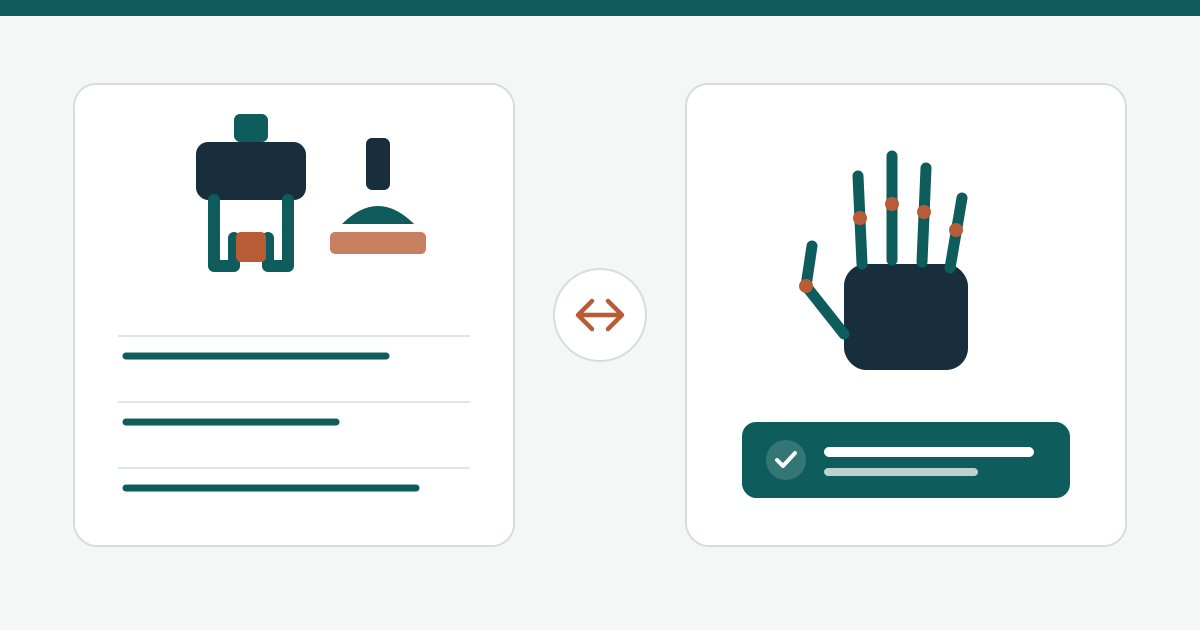
Multi-fingered dexterous hands make compelling demo videos. Watching a five-finger robotic hand spin a cube, press a button or hold an egg makes it easy to assume that a human-like hand is automatically an upgrade over a two-jaw gripper. On a real factory floor or in a commercial deployment, the opposite is often true.
Every extra finger adds motors, linkages or tendons, sensors, wiring, mass at the end of the arm and control complexity. Good end-effector sourcing starts with a simple rule: use the simplest industrial gripper that reliably handles your parts—and step up to a dexterous hand only when the task genuinely demands human-like multi-finger manipulation.
Start here: do you actually need a dexterous hand?
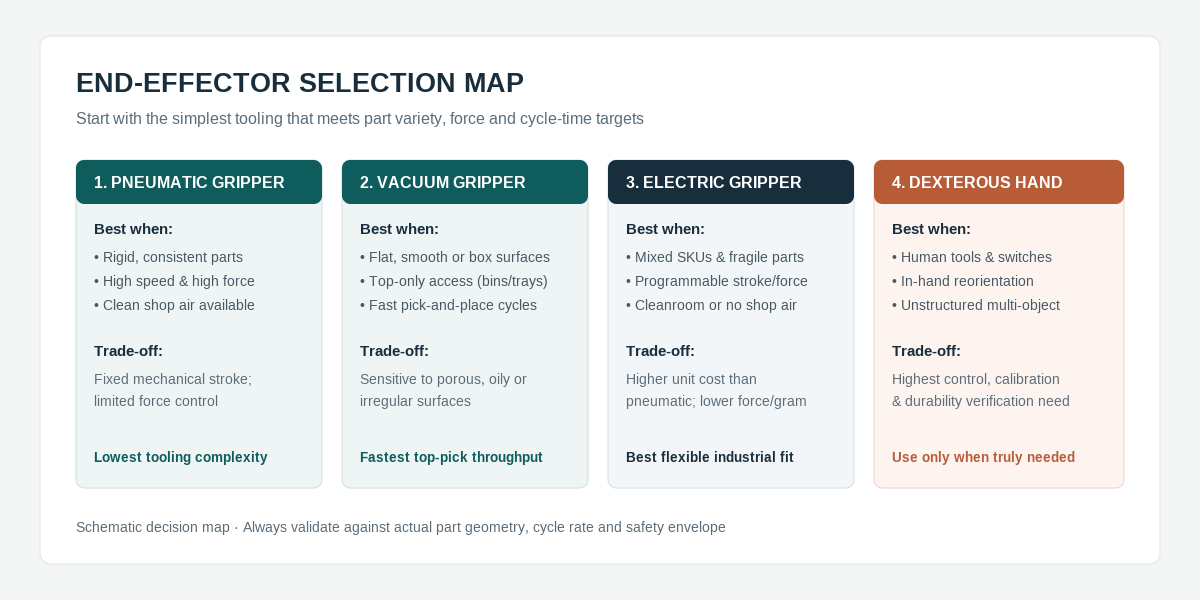
As industrial tooling primers from suppliers such as Festo emphasize, end-effector selection should be driven by workpiece geometry, gripping force, cycle time, utilities and failure behavior—not by how impressive the hardware looks. Before requesting quotes for a multi-finger hand, benchmark your task against the three proven industrial gripper families:
| End-effector type | Where it wins | Key limitation | Typical best-fit tasks |
|---|---|---|---|
| Pneumatic gripper | High force-to-weight ratio, fast cycle time, low unit cost and simple controls | Fixed mechanical stroke; needs clean compressed air; limited force feedback | Rigid parts with consistent size on high-speed pick-and-place or machine-tending lines |
| Vacuum gripper | Fastest top-surface picking, lightweight, easy multi-cup arrays for cartons or sheets | Struggles with porous, heavily textured, oily or irregular surfaces | Packaging, palletizing, glass/sheet handling and tight bin picking from above |
| Electric gripper | Programmable stroke and gripping force, part-width feedback, no compressed air required | Higher unit cost than pneumatic; lower peak force per gram | Mixed-SKU assembly, fragile workpieces, cleanrooms and collaborative robot cells |
| Multi-finger dexterous hand | Operates human tools, switches and knobs; performs in-hand reorientation across varied shapes | Highest unit cost, wrist-payload consumption, control complexity and maintenance verification need | Humanoid robots, lab automation with human instruments and unstructured multi-object manipulation |
In practice, a large share of industrial tasks pitched as “multi-object grasping” are solved faster, more reliably and at far lower total cost with a programmable electric robot gripper (often searched as an “electronic gripper”), a multi-zone vacuum gripper, or an automatic tool changer swapping two simple grippers.
When a five-finger dexterous hand is genuinely justified
Stepping up to an articulated multi-finger hand makes engineering sense when at least one of these conditions holds:
- The environment is built for human hands: The robot must operate standard hand tools, pull triggers, turn valves, open latches or use existing laboratory and service equipment without redesigning the workspace.
- In-hand manipulation is required: The task cannot be completed by simply picking and placing—the fingers must reorient, align or stabilize an object while holding it.
- Extreme object variety with no room for tool changers: On a mobile manipulator or humanoid robot, carrying a rack of swappable industrial grippers is impractical, and one adaptive hand must transition across very different shapes.
Once you confirm a dexterous hand is truly needed, the procurement challenge shifts: demo videos show what a hand can do once under ideal conditions, whereas production requires repeatable, comparable specifications.
Five specification layers to normalize before comparing dexterous-hand datasheets
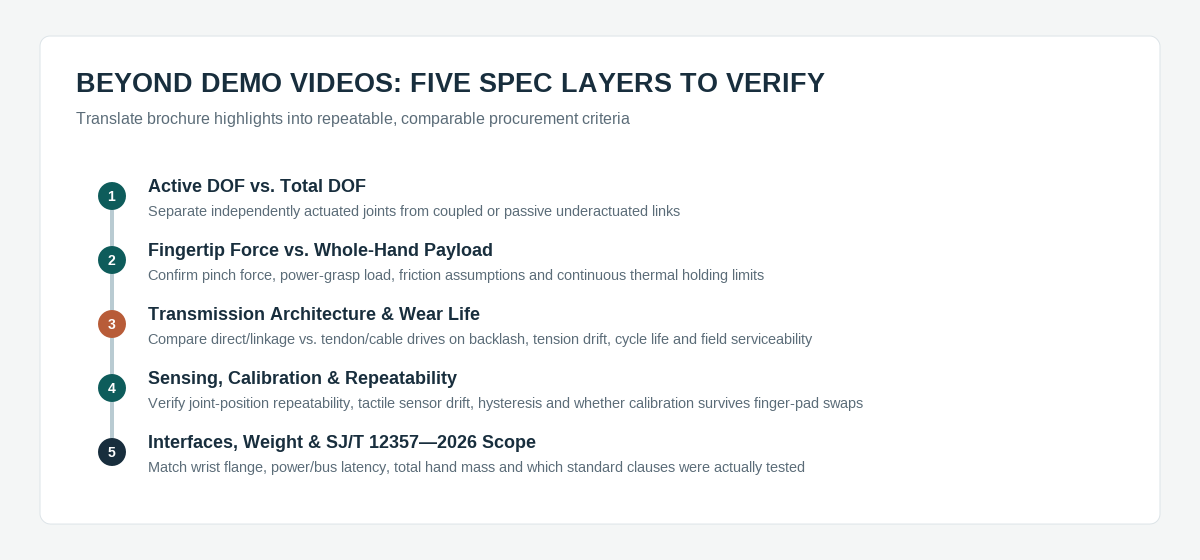
Because multi-finger hands are still a fast-evolving category, two brochures can use the same headline terms while measuring completely different things. Align these five layers before putting quotes side by side:
| Specification | What to clarify before comparing | Why it matters in practice |
|---|---|---|
| Degrees of freedom (DOF) | Separate active (independently actuated) DOF from passive or mechanically coupled joints | A “20-DOF” hand with 6 motors behaves very differently from one with 16+ active actuators. |
| Fingertip force vs. whole-hand payload | Distinguish single-finger pinch force (N), full-hand power-grasp load (kg), friction assumptions and holding duration | A peak pinch number measured for two seconds does not tell you what weight the hand can carry continuously without thermal derating. |
| Transmission & wear path | Identify direct micro-actuators, rigid linkages or tendon/cable drives; ask for backlash, cable-tension drift and service intervals | Tendon-driven hands can save finger mass, while linkage/direct drives can simplify service—each has distinct wear and recalibration needs. |
| Repeatability & tactile sensing | Request joint-position repeatability, tactile sensor resolution, drift, hysteresis and whether calibration survives finger-pad replacement | Raw sensor-array counts do not guarantee stable closed-loop force control over thousands of cycles. |
| Mass, wrist flange & control interface | Confirm complete hand weight (including drive electronics and cables), ISO wrist flange pattern, bus protocol (CAN FD, EtherCAT, RS-485) and control loop rate | Every extra 100 g at the wrist reduces usable arm payload and increases torque demand on shoulder and elbow joints. |
What China’s SJ/T 12357—2026 standard tells dexterous-hand buyers
In November 2026, China’s Ministry of Industry and Information Technology (MIIT) approved SJ/T 12357—2026 (Humanoid robots and embodied intelligence — Technical specification for dexterous hands), a recommended electronics-industry standard. According to MIIT’s official Annex 1, it covers technical requirements and test methods across appearance and degrees of freedom, motion, sensing, object grasping, object manipulation, interfaces, electromagnetic compatibility (EMC), environmental adaptability and reliability, plus modeling and simulation guidance.
Two practical boundaries matter for buyers:
- Keep the joint and hand standards separate: China’s integrated-joint standard (
SJ/T 12356—2026) explicitly excludes small joints inside dexterous hands—those fall underSJ/T 12357—2026. - Recommended standard, not a standalone certificate:
SJ/T 12357—2026is a recommended Chinese industry standard, not a mandatory national law or an export certification. Because RoboPallas has reviewed the official announcement and Annex 1 summary—but not the full published text—exact pass/fail thresholds remain unverified here. If a supplier referencesSJ/T 12357—2026, ask which edition, clauses and test items (motion, sensing, grasping, EMC or reliability) were actually tested and request the underlying reports. For the full legal context, see our MIIT standards briefing: https://robopallas.com/insights/miit-five-humanoid-robot-industry-standards-2026/
A constructive pre-purchase checklist for buyers and suppliers
Clear technical requests help both the buyer and capable suppliers avoid mismatched expectations. Before committing to a prototype or pilot order, ask for:
- Exact active vs. passive DOF breakdown plus full mechanical dimensions, wrist flange drawing and complete hand mass.
- Force and thermal test basis: Peak vs. continuous fingertip force and whole-hand holding load, with duty cycle and ambient temperature stated.
- Endurance and maintainability data: Rated cycle life under load, expected wear components (finger pads, tendons, gears), replacement procedure and spare-part lead times.
- Control and SDK package: Communication protocol, control update rate, ROS/SDK support, fault/overcurrent behavior and power-off holding state (important for cell safety under ISO 10218-2:2025).
- Sample-part grasp verification: A live or unedited test on your actual workpieces—including worst-case slick, fragile or irregular parts—showing repeatable grasp, transfer and release.
Related sourcing guides and resources
- Robot end-effectors explained: https://robopallas.com/guides/robot-end-effectors-explained/
- How to choose an electric robot gripper: https://robopallas.com/guides/electric-gripper-selection/
- Pneumatic robot grippers basics: https://robopallas.com/guides/pneumatic-grippers-basics/
- Vacuum grippers basics: https://robopallas.com/guides/vacuum-grippers-basics/
- MIIT five humanoid robot industry standards briefing: https://robopallas.com/insights/miit-five-humanoid-robot-industry-standards-2026/
To discover end-effector and component suppliers, browse the RoboPallas supplier directory: https://robopallas.com/suppliers/. Directory listings are for discovery only and are not an endorsement, recommendation or certification.
Unknowns and limits
- This article is a vendor-neutral engineering and procurement methodology; RoboPallas has not run independent comparative lab benchmarks across commercial dexterous hands or grippers.
- The full published text of
SJ/T 12357—2026was not available for this review, so its detailed numeric thresholds and test fixtures remain unverified. - Real-world durability, tactile sensor stability and total cost of ownership depend heavily on task duty cycle, environment and integration quality, and must be verified on physical samples.
Sources
- MIIT, Announcement No. 30 of 2026, dated 10 November and posted 16 November 2026; Annex 1, item 122 (
SJ/T 12357—2026): https://www.miit.gov.cn/zwgk/zcwj/wjfb/gg/art/2026/art_eb2325cb1a844fe99958eb8d104a34fc.html and https://www.miit.gov.cn/cms_files/filemanager/1226211233/attach/202611/6d2b9d84f80c435fb9c2feff84529863.pdf - RoboPallas, “China’s First Five Humanoid Robot Industry Standards: What They Cover—and What They Don’t,” 19 November 2026: https://robopallas.com/insights/miit-five-humanoid-robot-industry-standards-2026/
- Festo, Gripper Product Categories and How to Choose the Right Robot Gripper in Five Steps: https://www.festo.com/gb/en/c/products/grippers-id_pim227 and https://www.festo.com/us/en/e/blog/in-practice/how-to-choose-the-right-robot-gripper-id_4159813
- Festo, Basic Principles of Vacuum Technology: https://media.festo.com/media/114150_documentation.pdf
- ISO 10218-2:2025, Robotics — Safety requirements — Part 2: Industrial robot applications and robot cells: https://www.iso.org/standard/73933.html