
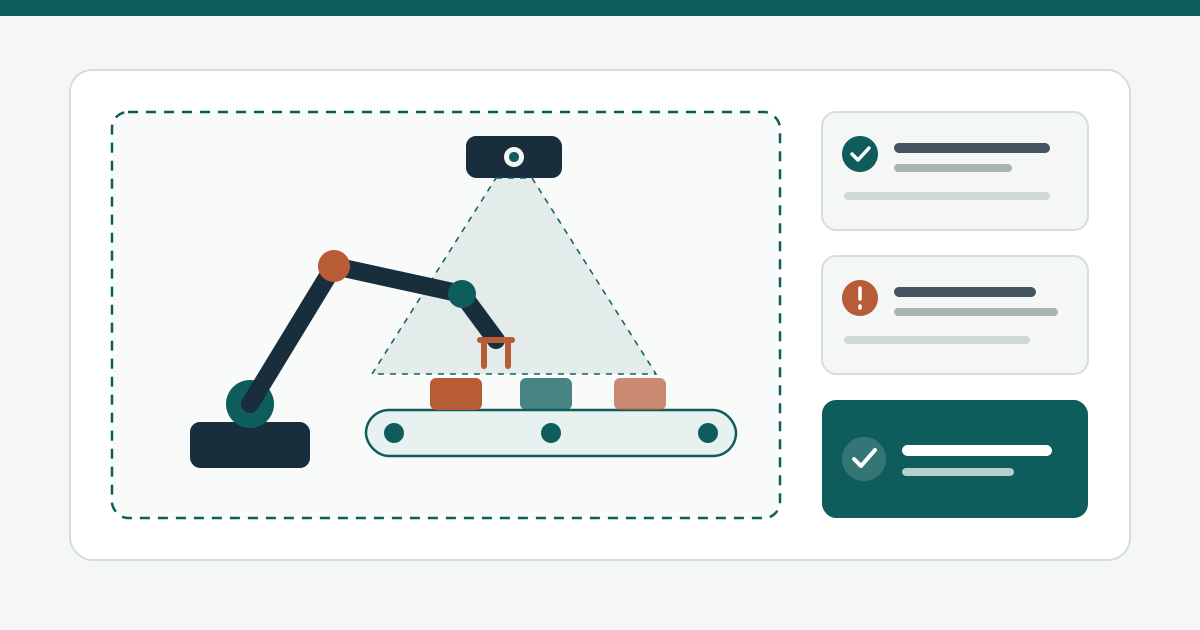
When a cross-border robot workcell project runs over budget or misses its launch date, the robot arm is rarely the culprit. Most delays happen in the gray zones around the arm: who owns the end-of-arm tooling, how the camera handles real factory lighting and glare, what happens when the cell meets local safety rules, and whether anyone tested the full cycle on real production parts before the crate left China.
A robot arm is only one subsystem inside a working cell. Whether you are buying a turnkey vision-guided picking cell or a pre-integrated robotic module to connect to your existing line, the fastest way to protect schedule and budget is to lock down scope boundaries, vision assumptions, safety responsibilities and acceptance gates before you sign a purchase order.
Why the robot arm is only a fraction of a workcell quote
Two quotations for the “same” picking cell can differ by 30% to 50% simply because one quote prices a bare hardware bundle and the other prices a commissioned production cell. As industry data from the International Federation of Robotics (IFR) and commercial cell manuals (such as ABB’s Robotic Parcel Inductor documentation) make clear, a functional workcell combines mechanical fixtures, end-of-arm tooling, sensors, controls, safety hardware, utilities and plant-level integration.
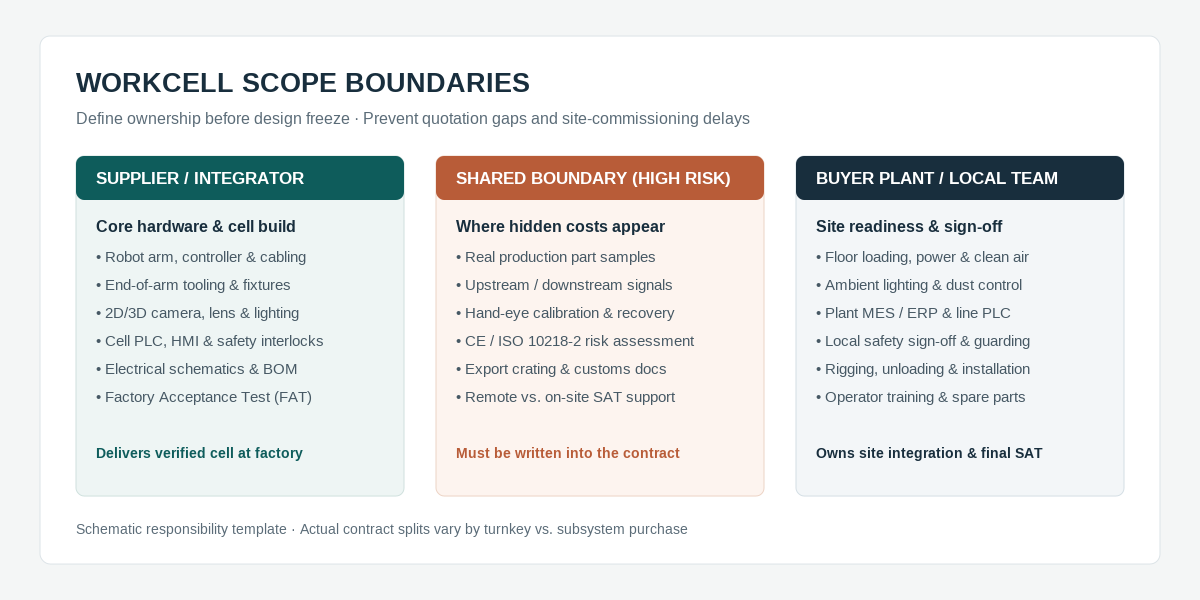
Before comparing prices, map every line item across three buckets: what the supplier builds, what your plant team owns, and what sits on the shared boundary.
| Workcell subsystem | Common quotation gap | What to specify before design freeze |
|---|---|---|
| Robot arm, controller & dress pack | Cable length, external I/O cards, fieldbus licenses and spare dress packs left out | Exact model, reach, payload margin (including gripper + cabling) and required fieldbus protocol (PROFINET, EtherCAT, EtherNet/IP). |
| End-of-arm tooling (EOAT) & fixtures | Standard catalog gripper quoted instead of custom fingers, tool changers or part nests | Worst-case part weight, surface finish, tolerance spread and quick-change requirements across all SKUs. |
| 2D or 3D vision & lighting | Camera priced without industrial lens, enclosure, external lighting or mounting bracket | Exact camera/lens spec, working distance, ambient-light shielding, calibration target and backup spare unit. |
| Cell PLC, HMI & line handshake | Cell runs standalone in the vendor’s shop but lacks handshakes to your conveyor or MES | Full I/O signal list, fault/recovery states, HMI language (English/French/Spanish) and remote-diagnostics access rules. |
| Safety perimeter & guarding | Light curtains, area scanners, interlocks or fencing assumed to be “buyer supplied” | Exact guarding layout, E-stop architecture, door interlocks and who signs the final risk assessment under destination-market rules. |
| Utilities & site prep | Power voltage/frequency (e.g., 400 V 50 Hz EU vs. 480 V 60 Hz US), clean dry air, floor anchoring | Exact electrical panel standard, breaker ratings, compressed-air pressure/filtration and footprint drawings. |
| Export crating, shipping & SAT | Quote ends at EXW/FOB with no commissioning days or re-calibration support on site | Incoterms, shock/moisture crating, included remote vs. on-site commissioning days and daily overtime rates. |
2D vs. 3D vision: lock down the physical reality, not just camera megapixels
Vision-guided picking cells fail far more often from untested physical variation than from software bugs. A camera that picks clean, matte parts under controlled lab LEDs can struggle on a factory floor with oily metal, shrink-wrap glare, mixed bin depths or shifting skylight.
Technical documentation from vision suppliers such as Cognex highlights two fundamentals every buyer should put into the technical specification:
- Match the dimension to the part presentation: Use 2D machine vision when parts sit on a flat plane at a fixed height (for example, singulated on a conveyor or tray) and you only need X, Y and in-plane rotation. Move to 3D vision (such as laser triangulation or structured-light sensors) when parts overlap, vary in height, or sit randomly inside bins.
- Treat lighting and hand-eye calibration as core deliverables: Hand-eye calibration maps pixel coordinates into robot base coordinates. If a forklift bumps the camera mast or a maintenance technician swaps a lens, the cell needs a documented, repeatable re-calibration procedure your local team can run in minutes—not a black-box setup only the original programmer understands.
Before freezing the vision design, send the integrator real production parts—including your ugliest valid samples (scratches, color variation, reflective packaging, slight warpage)—and require test images and cycle-time logs under realistic lighting.
Safety compliance: factory build vs. destination-market sign-off
In cross-border sourcing, safety compliance is the single most common source of late surprises. Under ISO 10218-2:2025 (Robotics — Safety requirements — Part 2: Industrial robot applications and robot cells), safety applies to the integrated robot application and cell as a whole, not just the bare robot arm.
That distinction has three practical consequences for overseas buyers:
- A CE-marked robot arm does not make the whole cell compliant: Adding a custom gripper, conveyor, vision frame and safety fence creates a new machine assembly that requires a cell-level risk assessment and compliance file for the destination market (for example, CE marking in the EU or ANSI/RIA and OSHA-aligned compliance in North America).
- Decide who owns the formal declaration early: Some Chinese integrators build to ISO 10218-2 principles and supply electrical drawings, component certificates and draft risk assessments, while the overseas buyer or a local notified/engineering partner completes final on-site guarding validation and declaration of conformity. Either split can work—as long as both sides agree on it before fabrication starts.
- Check electrical and control-cabinet norms upfront: Confirm voltage, frequency, wire color codes, UL/CE-listed safety relays, lockable main disconnects and English/local-language warning labels before the cabinet is wired.
Factory Acceptance Test (FAT) and Site Acceptance Test (SAT): five gates that protect both sides
A clear acceptance plan helps both the buyer and a capable supplier: it replaces vague expectations with measurable pass/fail criteria before the machine ever gets crated.
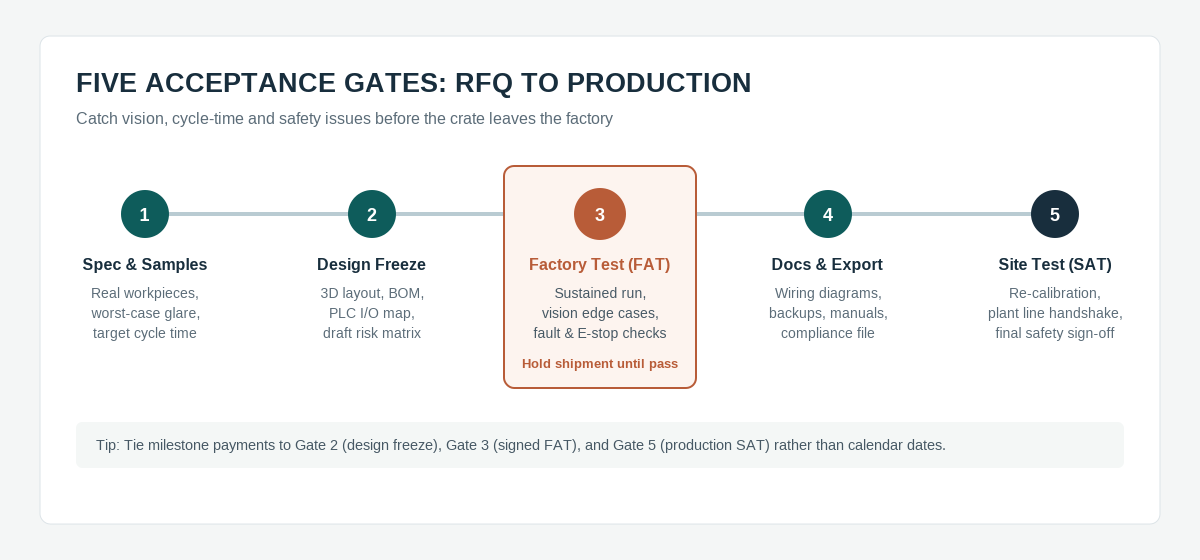
Before authorizing shipment at Gate 3 (FAT), verify the cell—either in person or via live, unedited multi-camera video—against these six checks:
- Sustained cycle run, not a 30-second clip: Run the cell continuously at target speed on real buyer-supplied workpieces for an agreed batch or duration (for example, several hundred consecutive picks or a multi-hour endurance run), logging actual throughput, pick success rate and miss/retry rates.
- Vision edge-case stress test: Intentionally introduce rotated, touching, slightly misaligned or worst-case reflective parts, plus controlled ambient-light changes, and confirm how the vision system rejects or recovers without crashing the arm.
- Repeatability and accuracy check: Verify pick-and-place repeatability at key fixtures using clear reference criteria (aligned with ISO 9283 concepts where applicable) rather than relying solely on the bare robot’s catalog repeatability.
- Safety and fault-recovery drill: Trigger E-stops, open safety gates, break light curtains, simulate vacuum/air-pressure loss and simulate a “no-part-found” vision fault. Confirm the cell stops safely and restarts cleanly without manual homing hacks.
- Complete documentation handover: Before releasing the FAT payment, confirm delivery of native/unencrypted PLC & robot backups (as contracted), electrical schematics, pneumatic diagrams, full BOM with off-the-shelf part numbers, vision calibration guide and maintenance manuals.
- Clear punch list for SAT: Log every minor open item with an owner and deadline, and define what must be re-verified at Gate 5 (SAT) after shipping—especially mechanical alignment, hand-eye re-calibration, upstream/downstream line handshakes and final on-site safety validation.
Related sourcing guides and resources
- Robot workcell components guide: https://robopallas.com/guides/robot-workcell-components/
- 2D machine vision for robots: https://robopallas.com/guides/2d-machine-vision-for-robots/
- 3D vision for robot picking: https://robopallas.com/guides/3d-vision-for-robot-picking/
- Vision-guided robot picking cell guide: https://robopallas.com/guides/vision-guided-robot-picking-cell/
- Robot cell factory acceptance (FAT) guide: https://robopallas.com/guides/robot-cell-factory-acceptance/
- Robotics quotation scope checklist: https://robopallas.com/guides/robotics-quotation-scope/
To explore robotics and vision companies, browse the RoboPallas supplier directory: https://robopallas.com/suppliers/. Directory listings are for discovery only and do not constitute an endorsement, recommendation or certification.
Unknowns and limits
- This article provides a vendor-neutral engineering and procurement methodology; RoboPallas has not independently audited or benchmarked individual workcell integrators.
- Legal conformity procedures (such as EU CE marking under the Machinery Regulation or North American electrical/safety inspections) depend on the exact destination jurisdiction, application hazards and contract structure, and must be confirmed with qualified local compliance engineers.
- Realistic FAT run lengths, acceptable pick-failure rates and milestone payment splits vary widely by industry and part complexity and should be negotiated directly in the project specification.
Sources
- ISO 10218-2:2025, Robotics — Safety requirements — Part 2: Industrial robot applications and robot cells: https://www.iso.org/standard/73933.html
- ISO, Robotics safety standards overview (ISO 10218 series): https://www.iso.org/cms/live/live/en/sites/isoorg/home/sectors/engineering/robotics.html
- ISO 9283, Manipulating industrial robots — Performance criteria and related test methods: https://www.iso.org/standard/22244.html
- Cognex, Vision-Guided Pick or Place Workflow and Hand-Eye Calibration: https://docs.cognex.com/isvs_2610/web/EN/InSight_Sheet/Content/Topics/HowTo/VGR/VGR-guide-pick-or-place.htm and https://docs.cognex.com/isvs_2610/web/EN/InSight_Sheet/Content/Topics/HowTo/VGR/VGR-hand-eye-calibration.htm
- Cognex, Operation of a 3D Triangulation Sensor: https://docs.cognex.com/is3d_130/web/EN/3D-L4000/Content/Topics/introduction/triangulation-sensor.htm
- ABB, Product Manual — Robotic Parcel Inductor (workcell subsystem integration reference): https://library.e.abb.com/public/72784c7ace1946b5a7fba91520c70640/4GAA412009901_en_A_Product%20Manual%20-%20Robotic%20Parcel%20Inductor.pdf
- International Federation of Robotics (IFR), World Robotics — Industrial Robots, Chapter 1: Market Participants and Distribution Channels: https://ifr.org/downloads/press2018/WR%20Industrial%20Robots%202019_Chapter_1.pdf